Thoughts on South Sudan
News has emerged of the discovery of mass graves in South Sudan, as the country descends into civil war. I thought i’d say a few things after working there in November.
First, the mainstream media coverage has been awful. When the crisis kicked off 10 days ago it was obvious something nasty was afoot, yet the story didn’t make it to the top of websites for the whole week, meriting only a couple of brief reports on the international sections of the BBC and Guardian. On Thursday I saw a confused-looking Beeb anchor mention the conflict briefly on TV. News websites were too busy grappling with the intricacies of the Nigella Lawson case and crap like “Smartphone smackdown: The best (and worst) devices of 2013” (The Guardian). Some outside journalists couldn’t enter the country because the borders were temporarily closed, but that should be no reason to ignore the conflict. News outlets could have used newswires and local reports. Radio Tamazuj seems much more informed than its British or American counterparts.
It was only this week that the story hit the top of the news agenda, after the death of an estimated thousand or more and after tens of thousands of people were forced to leave their homes. Twitter has throughout been much more useful than the international press, with informed locals sending messages from the capital, Juba, several informed foreign journalists messaging from home, as well as a few people tweeting from the ten provinces. I emailed several of my contacts, all of whom were OK. As my friend Marco pointed out on Facebook, for the Guardian to trumpet their man as the first foreign reporter to enter the country smacked of the same old paternalism that’s afflicted the continent for centuries. Reuters and local media have been reporting on the crisis since well before the arrival of the foreign press pack.
As so often the causes of the conflict were personalised. Foreign diplomats were reported as saying that President Salva Kiir “wasn’t the man they used to deal with” and that his former vice president Riek Machar, with his PhD from Bradford — as if that matters — appeared more power-hungry than before. The international press has paid hardly any attention to the political institutions (or lack of them) that allowed the current situation to develop, or to the international pressures which might have influenced the schism.
And we wonder why newspapers are in decline.
Second, contrary to what the legion of instant experts soon to hit the airwaves will say, nobody saw this coming. I’m relatively ignorant about the country, having only spent a fortnight there (writing about trade policy), so my view isn’t very important, but not one of the roughly 30-40 people I spoke to in the country mentioned the possibility of armed conflict, still less inter-ethnic violence. I didn’t read any analyses saying that widespread inter-ethnic violence was a risk, although my reading wasn’t exhaustive. Most of the people I spoke to rightly pointed to Khartoum as the source of their fears, rather than Dinka or Nuer. Warnings were issued about ongoing violence in states like Jonglei and at the disputed border with the north, not that the crisis would take the current form.
Retrospectively, of course, it’s always possible to build a story which sees ethnicity and armed conflict long bubbling below the surface. Many senior government staff are former senior army officers who have been given their positions as a reward for decades spent fighting for independence, and to stop them returning to make trouble in the provinces.
The South Sudanese who didn’t fight in the war were reportedly less likely to be promoted afterwards. Before 2005 some worked in Khartoum, where they were confined by to the middle ranks of the civil service. A few people suggested to me that Khartoum deliberately sabotaged the government of the South by promoting weak officers to senior posts just before independence. Put bluntly, many didn’t know what they were doing. After the oil was shut off earlier this year government revenues went into decline, which meant that many government employees went unpaid for several months. Their discontent might have stoked the violence.
Europeans and Americans have a tendency to put too much faith in the peaceful conciliation that comes about through democratic processes, and perhaps a naked power-clash like the one currently being perpetrated by president Kiir was always in the offing, particularly in such a new country and after two civil wars spanning 39 years – together said to be the world’s bloodiest, in which 1.5 million died.
Education and guns matter. A country saturated with AK47s was never likely to remain peaceful forever. Denied the right to attend school only a 27% of people are literate, defined by the UN as the proportion of adults over 15 able to read and write a simple sentence. Globally that’s higher only than the neighbouring Central African Republic. A mere 1.7% of people go to secondary school. It’s not patronising to suggest that some people settled scores by violence, not discussion, and that leaders can readily convince the uneducated that the tribal ‘other’ is to blame for their problems.
Health indicators are little better. Of every thousand live births 105 children never reach their first birthday. In Cuba, a global health exemplar, the comparable figure is six. South Sudanese have a fifty-fifty chance of living below the national poverty line, but their poverty-stricken years are unlikely to last because people die at an average age of 42. I suppose that in a new country the window of opportunity for tackling these horrifying social indicators is relatively short, and when people don’t see their lives improving they will look for scapegoats.
And people’s lives outside the capital weren’t improving quickly. Economic opportunities appeared incredibly limited in many of the provinces. In Malakal, in the northern state of Upper Nile, I asked one interviewee about the main barriers to trade. In other countries the answer is usually technical, like the cost of credit, difficulties with property rights or delays with customs clearance.
“Electricity,” he said, “and roads”. The entire province – which covers an area seven times that of Yorkshire – contains almost no tarmac apart from a couple of short stretches near the oilfields near the border with Sudan. The state has a wealth of resources: oil; gum Arabic (which is used in fizzy drinks and which the South Sudanese have tried in vain to rename Gum Africa); fertile land but no infrastructure or the ability to exploit those resources apart from sending oil via pipeline to Port Sudan for refining elsewhere. The official border at Renk was closed and almost all goods from Sudan are smuggled.
(Incidentally while in Malakal we met the sister of Pagan Amum Okiech, the Secretary General of the Sudan People’s Liberation Movement, who is currently under detention for allegedly plotting the current unrest.)
It probably goes without saying, but infrastructure is very basic. Most roads are rough tracks. We crossed the only bridge out of Juba, a decades-old military affair spanning the White Nile which looked as if it could collapse at any moment. Lorries were backed up to the river’s edge syphoning water from the river for transport round town in tankers. Our taxi driver said that until last year some had been transporting sewage and water in the same tank, and that sometimes you’d be having a shower and “shit would fall on your head”. He seemed to find this incredibly funny. Until two years ago three was apparently no readily-available good drinking water in the town, although now 25 companies bottle water — affordable only for the middle-class, of course.
The Ministry of Transport compound ironically couldn’t be reached except by a very good four-wheel drive. There are almost no small cars in town, and almost every vehicle seems to be a Toyota Landcruiser, probably not paid for out of a senior government salary of about $1000 a month. The only two good paved roads in the capital run mostly between the government offices and aid agencies. The other routes are via terrible muddy tracks which are best avoided. We sat in a jam for ten minutes near a three-way junction. Traffic lights are unknown. Hotels are springing up everywhere, a contrast, I am told, to the pre-independence days when most visitors stayed in tents.
What strikes me as so saddening is that South Sudan will be dismissed by the world as just the latest disastrous African tribal conflict, yet I met a lot of peacable, educated and hard-working people who only wanted their nation to succeed and who were well capable of identifying the real sources of underdevelopment. The explanation is much more complex than just two tribes having at each other. As the traffic jams and new hotels showed, at least in the capital things were booming. Economic growth was so rapid this year that the Economist touted the nation as one of the world’s best-performers. In last week’s print edition it considered South Sudan as a possible “country of the year” but counted it out because of the volatile nature of growth:
Focusing on GDP growth would lead us to opt for South Sudan, which will probably notch up a stonking 30% increase in 2013—more the consequence of a 55% drop the previous year, caused by the closure of its only oil pipeline as a result of its divorce from Sudan, than a reason for optimism about a troubled land.
As an uninformed outsider, if I were to point to one particular cause of the conflict i’d pick out the low level of institutional development. A poor, war-torn country just can’t develop a functional legal system and democracy in two years. Lots of foreigners from rich countries forget that their systems took hundreds of years to develop, often in unspoken, tacit ways. Britain doesn’t even have a written constitution. In any case, writing things on bits of paper is often completely useless. The 2011 South Sudanese constitution is the sort of thing that would give Norwegians wet dreams — and in fact it was drafted with the help of well-meaning European lawyers. It’s full of politically-correct statements about gender equality and human rights, all of which are being resolutely violated.
Civil servants aren’t fully trained, and many are politically appointed or put in place for reasons of expediency rather than because they’re any good at doing their jobs. The state clearly struggled to legitimise itself through monopolising the legitimate use of violence, as students of Max Weber would attest. All of these institutional ingredients need strong long-term international support and funding.
But as the recriminations fly it’s worth remembering that few people, least of all myself, saw the conflict coming, despite the poverty, and despite the poor state of education, health, infrastructure and institutions. It’s probably too soon to start pointing fingers at the UN, or the Chinese, or the Americans, or only one side or other in the political conflict. If the finger-pointers were so wise they’d have said something before the event. What’s obviously crucial in the near term is for the president and Machar to hold public talks aimed at stopping the violence in an effort to stop it getting even further out of hand, and for foreign news agencies to report it properly regardless of Western weariness — and even if it spoils our Christmas dinners.
Nepalese tribesmen falling out of trees
An excellent paper by Kaushik Basu argues that randomised controlled trials (RCTs) in development economics can’t establish causality:

To be aware of our own minds’ propensities, it is at times useful to take cognizance of the very different beliefs found in other cultures, which those cultures consider perfectly reasonable. The Gurung tribesmen of Nepal spend a lot of time climbing dangerously high trees to gather honey. When the French photographer, Eric Valli, who worked extensively among the Gurung, asked them if they do not ever fall down from their high perch, they replied: “Yes, you fall when your life is over.” (National Geographic, vol. 193, no. 6, June 1998, p.92)
I quite like Basu’s conclusion, which is that whilst RCTs don’t establish causality they may describe a situation well. We should pay attention to them but we should also use our intuition.
What I am arguing is that by bringing … intuition and reason together, we can greatly improve our ability to make policies. Is my intuition consistent with the evidence we have and the other things I already know? Is it consistent with the other intuitive beliefs I hold? Reasoned intuition is intuition that has been subjected to this kind of interrogation.
In this and the next paragraph he more or less describes what I do when I write about trade policy in developing countries:
Empirical studies, no matter how carefully done, cannot in themselves lead us to particular policies. Going from evidence, data, and statistics to policy will invariably entail a leap of imagination.
Another clever argument:
Dollar, Kleineberg and Kraay (2013) have recently shown, using a remarkably comprehensive data set, spanning multiple countries and several decades, that the bulk of poverty reduction that the world has seen in the past was due to overall GDP growth. Intuition then prompts us to propose that we should therefore rely on growth rather than specially designed market interventions to battle poverty. For the untutored, the growth v. poverty debate is an emotive one and this observation quickly gathers support among those who have a predilection to leave it all to the market. Without going into this larger debate here… let me simply point to an obvious mistake that leads us to make this policy conclusion from this robust empirical finding. The fact that 75% of the drop in poverty in the past occurred because of growth in no way shows that growth is more effective in eradicating poverty than say a new conditional cash transfer program. The mistake in making that deduction would be the same as someone studying infections in the 1930s asserting that we should rely on non-penicillin medicines because past data shows that 99% of all cures were because of non-penicillin drugs. This ignores the fact that penicillin was discovered in 1928 and so the lack of evidence of the success of penicillin is not a sign of penicillin not working but of penicillin not existing.
Basu adds on page 20 that the mistake about assuming that growth reduces poverty would be the same as someone pointing out that the private sector creates jobs because past data show that 80% of jobs were created by the private sector. “If this logic were correct, we would also have to accept the logic of an economist in Soviet Russia in 1980 arguing that we have to rely on the state for job creation because past data show that 90% of all jobs were created by the state.”
Basu concludes:
What human beings know comes from many sources, and to deem only one method valid and all others invalid is to slow the process of knowledge acquisition. The catholicity of methods currently used—from anthropological notes, analysis of large data sets, everyday experience and randomized trials—all have a role to play in this enterprise.
Nelson Mandela and heterodox economics
The death of Nelson Mandela and heterodox economics don’t have much in common. But I’ve noticed at least one similarity: the relentless focus on the individual. Almost every journalist and politician deifies Mandela, holding him solely accountable for the overthrow of apartheid. It was his 27 years of jail and his dogged pursuit of “justice” which finally did for the apartheid regime.
Not a week goes by without an article or new movement criticising the standard-bearers of mainline economics for their inability to predict the crisis and their continuing silliness. The main targets are academics like Paul Krugman, John Cochrane and Greg Mankiw, who retort that despite its shortcomings mainstream modelling is the best tool we’ve got.
I’d be the first to say that people and ideas matter. Mandela was a hero, and it’s in the nature of his genius that those from across the political spectrum can find something to admire in him – rightwingers, his statesmanship and his ability to forgive; the left, his egalitarianism, perseverance and championing of the dispossessed.
I’ve also been quick to criticise the personalities of standard economics, with their ridiculous assumptions that make their theories so far removed from reality that in many circumstances they are worse than useless. The relentless flood of opposition to these people may help chip away at the edifice, bringing about a more realistic and human form of political economy.
But in both cases individuals and ideas are only responsible for so much; whilst important, at best they’re probably only the conduits through which the flood of history is channelled. Mandela (as many commentators in fairness point out) was the brilliant figurehead of a mass movement which would stop at nothing to dispose of a corrupt, fascistic and brutal regime.
Sooner or later apartheid would have ended, against the backdrop of a hostile global environment and an increasingly unviable economy whose principal beneficiaries could see little hope of long-term prosperity. The white middle and ruling class were not as opposed to democracy as might be supposed. They have benefited most in the ANC era, a time when poverty has remained entrenched and white-black inequality has worsened.
Mandela may be individually more responsible for the success of a social movement than any human being in history, and he may even have single-handedly hastened the end of apartheid, but ultimately he was a man of his time. It’s the interplay of history and personality that make the overthrow of apartheid so interesting – as Marxists and Weberians have long pointed out. Men make history but not in circumstances of their own choosing, you might even say.
Similarly no matter how much the cheerleaders-in-chief for mainstream economics are criticised, their discipline functions to support certain interests. Neoclassical economics isn’t neoliberalism – several leftish economists like Krugman and Simon Wren-Lewis are at pains to point out the anti-austerity credentials of textbook economics – but it does promote a fundamentally individualist, liberal, utilitarian worldview in which people act according to self-interest. This worldview is useful in our existing economic system.
Whatever the heterodox say, the main tenets of finance theory are alive and kicking. I’d even go so far as to say that they “work”, at least within the confines of making short-term money in investment banking if you’re not bothered about the social fallout. As the latest Nobel prize showed, the efficient markets thesis still has currency. It’s pretty much impossible to construct a credit derivative without at least some reference to financial economics. Business schools still teach this stuff because it’s in demand.
Keynes’s general theory was forged in the furnace of the great depression. It was a response to the bankruptcy not just of the banks but of classical economics. Even financiers and industrialists realised that raising effective demand and the possibility of the restoration of full employment were in their interests.
Despite enlightened political economists banging away for decades about the wrong-headedness of the mainstream, and the development of viable alternatives like post-Keynesianism, Modern Monetary Theory and complexity economics, few of these alternatives have made it on to mainstream syllabuses, and they don’t guide policy.
To that extent it’ll probably take a lot more than just criticism of individuals to overthrow mainstream economics, valuable as criticism is. New ideas are also important, and it’s great that certain imaginative political economists are readying them for when the time is right. But their acceptance may depend on which social and economic groups find them useful, and which ideas need replacing. People and ideas make history, but, depressing though it sounds, circumstances matter.
Scotland’s aid promises
The section on international development in the Scottish government’s white paper Scotland’s Future: Your Guide to an Independent Scotland is enlightened but leaves a few questions unanswered.
International development
Our priorities for action
With a focus on working in partnership and achieving real and tangible outcomes on the ground, the Scottish Government’s international development policy seeks to build upon the historical and contemporary relationships that exist between Scotland and the developing world. Scotland will seek to be a global leader in the field of international development, championing best practice and innovation. Being a global leader in international development is not necessarily just about the size of aid given in absolute monetary terms, but the impact that can be made across government policy. The provision of aid is one tool within international development and an independent Scotland would enshrine a legislative commitment to spending 0.7 per cent of Gross National Income on Official Development Assistance.
Delivering a coherent approach to international development across all Scottish Government policies – crucially trade, environment, defence and finance – would be the key to success and global impact. The Scottish Government therefore has several key propositions that will guide our approach to development. They are:
- More and better aid: The Scottish Government would meet from the point of independence, and thereafter maintain, the 0.7 per cent target, with an aspiration towards one per cent over time and ensure Scotland’s aid is of high quality, including through appropriate geographical and thematic focus. The Government plans to introduce a legislative basis to ensure adherence to the 0.7 per cent target as a binding, statutory commitment
- Debt relief: The Scottish Government will give careful consideration to the question of “unjust” debts; will work to ensure that Scottish export policies do not create new unjust debts; and support moves to establish Scotland as an international centre for debt arbitration
- Gender equality: Gender equality and the empowerment of women are Millennium Development Goals in their own right. They are also critical to the delivery of other key development goals including in education and health. An independent Scotland will put gender equality at the heart of our development work
- Do No Harm – ensuring policy coherence: As an expression of the values driving our foreign policy, this Government will ensure that other Scottish Government policies do no harm to developing countries, do not undermine international development aims and ideally contribute to international development success – through a rigorous approach to policy coherence for development. A key example of this approach is that our Climate Justice Fund and our International Development Fund are being developed and implemented within and across Government, providing a streamlined approach to both international development and climate change
Scotland’s international development programme will be delivered as part of an integrated approach to international relations. However, we will not allow commercial or other considerations, including military considerations, to influence our approach improperly.
Development sections within Scottish overseas offices will ensure effective delivery of programmes supported by the people of Scotland and will work closely with Scotland’s private and third sectors, and our civil society partners, to maximise the impact of both governmental and non-governmental efforts.
The Scottish Government intends under independence to work with the UK’s Department for International Development (DFID) to ensure that there is a smooth transition phase for programmes on the ground in developing countries. There will be continued support, where appropriate, to those DFID programmes which span the independence period to avoid any sudden disruption to those programmes and their recipients. International development is just one of the areas where future Scottish and Westminster governments can choose to work together to complement each other’s activity. Scotland is also likely to be a significant donor to multilateral organisations reflecting similar priorities as the UK in this area.
It’s all progressive stuff, especially the commitment to enshrine in law the 0.7% GDP target with the aim of reaching one percent. In Australia and Canada the new conservative governments this year reneged on their country’s promises, cutting international development assistance and merging development with their Departments of Foreign Affairs. Signing the Scottish aid commitment into law would help cut the chances of future governments backtracking: the SNP won’t necessarily govern forever after independence.
0.7% of GDP is a billion quid (using the Institute for Fiscal Studies‘s recent high-end estimates of Scottish GDP including North Sea oil output on a geographic basis), about 10 times what Scotland currently spends on aid. This would be a lot of welcome dosh, and Scotland has already shown it can spend aid money well.
As in Westminster, other departments are likely to get pissed off at the new Scottish overseas development agency raking in a mighty cash pile at a time when resources are stretched thinner than Jim Murphy’s lips. Ring-fencing aid tends not to inspire the love of education, health and transport ministers.
“Delivering a coherent approach to international development across all Scottish Government policies”, whilst laudable, might therefore prove a challenge. Hitting the target of one percent of GDP, which would place Scottish largesse among its generous Scandinavian neighbours, would be an even bigger ask.
But it’s still a good idea. Scotland has long had an enlightened political culture in which the needs of the worst-off are considered important, unlike the increasingly poisonous culture of Westminster in which the elitist fop Boris Johnson today set out his case for Tory leadership by “mocking the 16% “of our species” with an IQ below 85″.
Scotland, a country which profits from globalisation and which helped perpetrate some of the iniquities of colonialism, recognises that it must contribute to global welfare. Aid is in the interests of Scotland, promoting political stability and lowering the cost of doing business internationally (Sudanese piracy adds up to a tenth to shipping costs). Finally, Scotland gets to look good in the world.
The promise not to burden developing countries with more debt is another sensible piece of policy, as is pledging to “do no harm”. It’s no accident that the sections of the white paper before and after are on international relations and defence. Many thoughtful commentators recognise that rich countries and international institutions continue to undermine their international development efforts by flogging unwanted loans to the governments of poor countries, selling them arms and providing havens for dictators to hide ill-gotten cash. Alongside that billion quid it’s probably just as important to make sure Scottish companies don’t pollute the world, or exploit Chinese workers, or pay bribes to African kleptocrats.
Doing no harm, though, is easily fudgeable. That’s why i’d have liked to see a commitment to rein in the financial sector. One of the biggest pieces of harm done by rich countries over the past decade was to destabilise the world economy. The financial weapons of mass destruction so favoured by the likes of Royal Bank of Scotland caused mayhem in the developing world.
The collapse in international trade that followed the global economic crisis hurt all countries, developing and industrialised. When European orders for flowers dropped Kenyan farm workers sat idle. Foreign investment inflows dwindled. Overseas aid wilted as rich governments rejigged their budgets. By the time the rich recovered it was too late for the poor, for whom austerity meant eating less and not sending kids to school.
Why in the white paper was there no commitment to curbing tax evasion? For every dollar that goes in to developing countries, ten dollars drains out, partly facilitated by big finance and secrecy jurisdictions. Why so little to curtail finance? If Scotland really wants to show it cares about the world’s poorest it should promise to stamp out tax evasion and tackle tax havens. The City of Edinburgh should recognise that the City of London is no model to follow. The Royal Bank of Scotland debacle wasn’t just a tragedy for Britain, it was a problem for the world.
Salmond obviously doesn’t want to ruffle British government feathers unduly, so he’s obviously conciliatory on the issue of how to take over Scotland’s bit of the Department for International Development. Scottish development minister Humza Yousaf has promised to protect the jobs of the half of DfID staff who work in East Kilbride. It seems likely he’d transfer a lot of them to new Scottish government departments.
But lots of people think DfID is beginning to lose its enlightened edge, contracting out too many projects and confusing foreign relations with aid. It’d be good to see Scotland take a different path, keeping a proportion of important development jobs in-house and making sure that aid stays apolitical.
————
Not that it’s directly connected with aid, but on p.227 the white paper says Scotland will join the World Trade Organisation. Referring to the European Court of Human Rights, the Organisation for Security and Cooperation in Europe, the Organisation for Economic Co-operation and Development, the Commonwealth and the WTO, the paper says: “Each of these organisations has its own procedure for membership. Scotland is already a member of them through the UK, and so already meets the essential requirements. Following a vote for independence, the Scottish Government will initiate steps to ensure Scotland’s membership as an independent country as swiftly as possible.”
Not so fast. One of the areas I work on — WTO accession — has to be done according to a strict schedule. A working party of members is established and a process of negotiations undertaken under article XII of the WTO agreement. Of the 31 accessions to the WTO since it was formed in 1997 at least 11 were new countries which had split from a bigger one: Albania, Macedonia, Estonia, Kyrgyz Republic, Latvia, Lithuania, Moldova, Montenegro, the Russian Federation, Tajikistan and the Ukraine. All had to negotiate a separate accession agreement based on new negotiations. All underwent a more rigorous trade liberalisation process than predecessors based on the WTO principle of progressive liberalisation. Scotland’s trade policy is already very open as part of the UK, but it can’t expect to join the WTO automatically. Presumably it’ll have to go through the same process as the other 24 accessions currently underway.
39 country chart of life expectancy and health spending per capita
The untold story of the Pacific Islands
An article I wrote on the Guardian Development Professionals website:
The untold story of the Pacific Islands
Dan Gay
A dead pig lolls among the flotsam on South Tarawa beach. No children play in the water – unusual in the Pacific islands, where a childhood spent splashing in the ocean is an age-old rite. In Kiribati’s capital, years of poor waste disposal coupled with overpopulation and a limited supply of water have polluted the lagoon, making it too dirty to swim in. Over 50,000 people crowd into 2,500 acres, a population density twice as high as that of New York.
Although the Pacific islands are well-known as the first casualties of climate change, a tale less often told is of the environmental and energy crisis at home.
Years of mismanagement and poor policy have led to ecological and energy calamities across the region. Until this year no Pacific island country had an official trade policy. Few have national energy strategies. In many countries a lack of planning meant that the default policy was to exploit natural resources at an unsustainable rate. In the Solomon Islands, natural forests have been logged so uncontrollably that exports are expected to cease by around 2015. Local communities have long relied on logging as their only source of income and it has been one of only a handful of viable exports since independence.
Mining has a particularly bad record in the Pacific. A watershed moment came in 1999 when BHP, the former owner of the Ok Tedi gold and copper mine in Papua New Guinea, admitted that the mine caused “major environmental damage”. Up to 80m tonnes of contaminated waste were discharged into the river each year, displacing 50,000 people downstream and killing or poisoning fish as well as damaging staple crops. In September, the government said it would nationalise Ok Tedi to force BHP to pay more compensation.
Government policy makers, not just in departments of environment or energy but also in the bigger departments like finance and trade, are only just beginning to acknowledge these domestic crises, realising that if they’re asking the rest of the world to cut carbon emissions, then they should be tackling problems within their own borders.
The key to this new realisation must be an improvement in governance. The word has come to be associated with corruption, and this undoubtedly needs to be tackled. But governance also needs to be understood more broadly – as the ability of local people to control and shape their economies and environments.
The already tiny governments of the Pacific islands have long been told that good economics means shrinking the state and lowering public expenditure. But this has diminished the ability of these countries to manage public affairs, depriving them of the resources to limit the exploitation of natural habitats, to manage waste or to build efficient energy infrastructures.
Some international agencies have been complicit in this anti-state message, encouraging the idea that market forces will generate economic prosperity and that the private sector will look after the environment. The Asian Development Bank, for example, conducted structural adjustment programmes across the region in the late 1990s that led to swinging public-sector cuts, trade liberalisation and privatisation. Vanuatu was typical: the programme caused a recession, increased public debt and crippled the government’s ability to perform everyday functions including environmental protection. Donors need to acknowledge that ecological management requires a strong state, and that governments need to be allowed to learn from their mistakes.
Aid has often encouraged dependency, with policymakers often deferring to donors instead of making their own decisions. Pacific islanders are per capita the highest recipients of aid in the world, at $469 in 2011 according to the World Bank, over 20 times the world average.
Donors have often failed to stump up promised funds, breeding uncertainty. The last time I was in Tuvalu, in late 2010, the then prime minister told me that he didn’t soon expect to access the $100m promised to poor countries for national adaptation plans at the UN climate summit the previous month in Cancún. Critical though the global warming agenda is, it has also encouraged the perception that environment equals climate change, when domestic challenges are equally if not more important.
Strapped for cash, policymakers aren’t in a good position to easily manage their own energy or environmental policies. In Vanuatu the lack of an energy policy means that French monopoly Suez Unelco still has 40 years left on its concession agreement. Energy prices remain among the highest in the world and the country continues to rely heavily on imported diesel (although some coconut oil is used as fuel instead of exported). Suez Unelco has indicated that it may refuse to act as supplier-of-last-resort to any company generating its own wind or solar power.
Yet despite their mixed records, foreign companies and international agencies are beginning to wake up to the regional crisis in the making – and given the meagre resources of Pacific states, the international community must play a critical role.
Regional organisations like the Secretariat of the Regional Environment Programme, based in Samoa, have begun turning their attention to improved energy efficiency. The World Bank increasingly emphasises the importance of good governance in mining and energy usage, and the message is spreading in the region, supported by a host of international organisations.
The International Council on Mining and Metals, an industry group comprising of 21 major mining and metals companies as well as 35 national and regional mining associations, aims to encourage due diligence on social and environmental issues. Work includes social and economic development, environment and climate change, health and safety and recycling.
The Framework for Responsible Mining is a joint initiative of NGOs, retailers, investors, insurers, and technical experts working in the minerals sector outlining environmental, human rights, and social issues associated with mining. The framework recommends no-go zones for mining; develops criteria for environmentally responsible mining; tries to ensure that mines benefit affected communities; and puts in place principles of good governance.
Earthworks is a US-based non-profit organisation which aims to protect communities and the environment from the impacts of irresponsible mineral and energy development. Its strategy aims to improve corporate and government behaviour whilst aiming to improve the benefits to communities and the environment.
The initiative for responsible mining assurance involves mining companies, downstream users of mining products such as jewellers, non-government organisations, communities and workers to put in place standards and verification of good practice in mining. In 2015 the initiative will start certifying mine sites.
Global climate change is threatening the very existence of many of the islands. But sinking beneath the waves isn’t the only danger. Unless they put domestic and international resources to good use, the Pacific islands risk drowning in an energy and environmental crisis with its origins closer to home.
Mainstream economics doesn’t work in the Solomon Islands (or anywhere else)
I was lucky enough to spend the last two weeks working in Solomon Islands. My colleagues and I flew from Honiara to Munda in New Georgia, a remote island toward the border with Papua New Guinea. The airstrip in our final destination, the island of Gizo, was closed, so we travelled by speedboat across lumpy green seas for the final hour-and-a-half.

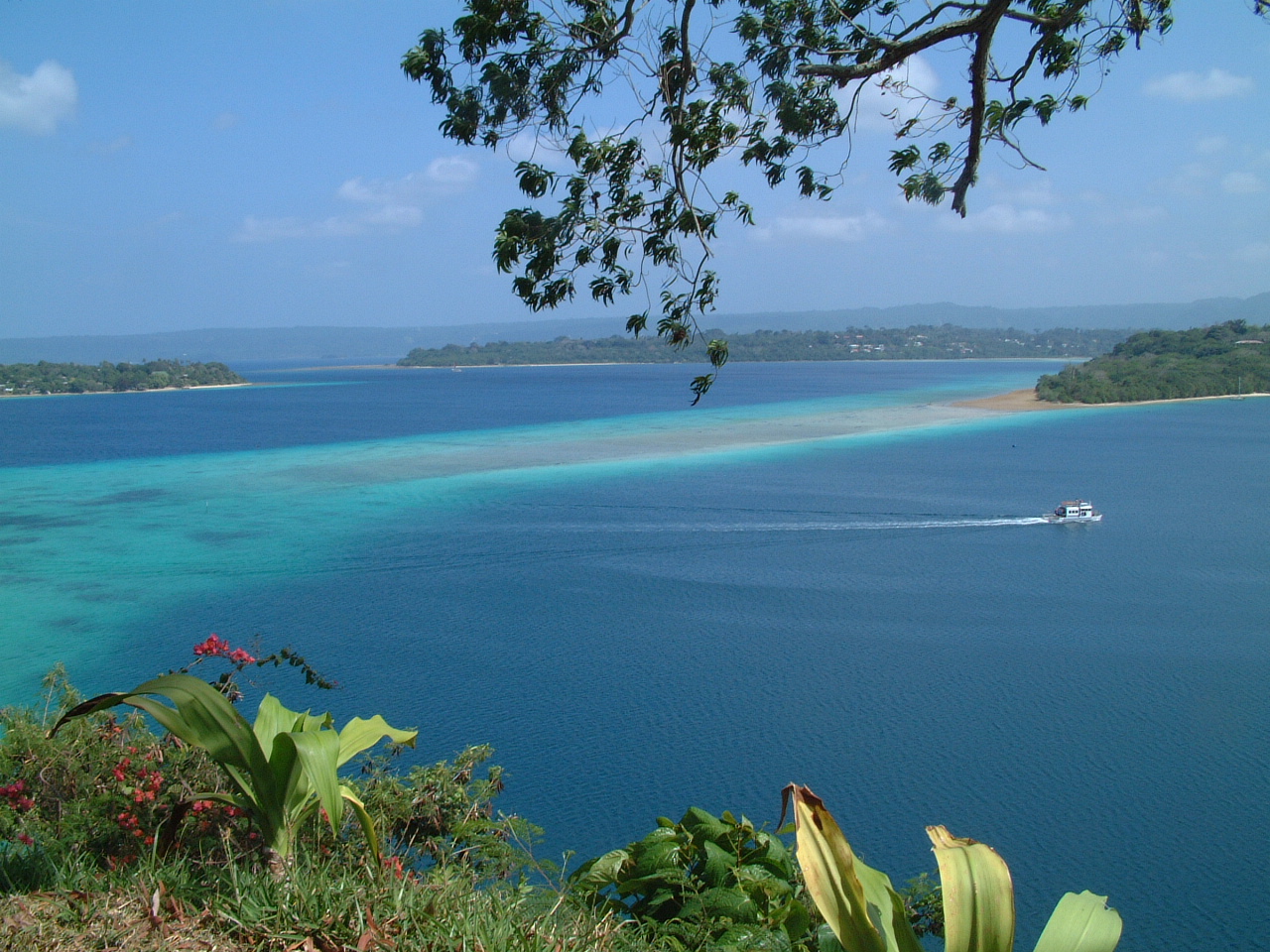
Not as paradisical as it looks
When we arrived I was glad to see that aid donors were building a new hospital and that the airstrip was being upgraded from coral to asphalt. The last time I visited, five years ago, a tsunami had destroyed most of the houses near the coast, sending the inhabitants to higher ground in the middle of the island where the UN had built a tent village.
This time there was little other sign of progress other than the hospital and airstrip. Bad weather meant that supplies hadn’t reached the island for several days. In a country surrounded by sea, we were surprised to discover that there was no fish to eat. Because of poor transport, people struggle to reach the main island, which means medical problems go undiagnosed and untreated. Even with a new hospital building medicines are likely to remain limited in availability and staff overworked.
The roads seemed just as bumpy as before, and by all accounts the tourist trade hadn’t picked up locally, a trend which was backed up by the national statistics which show that only about 22,000 visitors arrived in the country last year, little higher than four years previously.
In 2008 the Solomon Islands ranked 128th out of the 177 countries on the UN human development index, classifying the country as having ‘medium’ human development. Although the criteria for measurement of the index changed and more countries were added, four years later human development has been downgraded to ‘poor’, with the country ranking 143rd out of 186 countries.
Despite aid donor spending of around AU$3 billion (£1.75 billion) in the last decade, economic growth has slipped in recent years to around 4%, barely more than population growth. Average per capita income is only about US$1,100, but in the rural areas it’s considerably lower. People in Gizo and New Georgia told us they feel somewhat abandoned by the capital, Honiara, where most economic activity is located. Central government has very little influence, and i’m told that the more remote areas more or less fend for themselves.

Economic growth – middling
The Solomons, like many Pacific island states, is almost a libertarian wonderland. The state was already minimalist, but recent years have seen yet further liberalisation, government spending cuts and a move toward greater private ownership of industry. In 2007 import tariffs were lowered to three bands, with a maximum of 10%. The fisheries, forestry and mining industries are largely privately-run — and foreign donors encourage austerity.
If laissez-faire were really such a great idea you’d expect rip-roaring economic growth. The reality is quite the opposite. Because of poor control of forestry and weak environmental regulation, the export of logs from natural forests is forecast to drop to zero by around 2015. Mining hasn’t picked up as predicted. Despite the efforts of several motivated and qualified staff, the government struggles to exert much influence over the economy.
Liberalisation has deprived the Solomon Islands, like so many least-developed countries, of the tools to promote economic development. Industrial policy would never result in the development of a manufacturing sector — the country is too small and far from big markets. But some measure of strategic policy could lead to the development of certain economic sectors: agricultural processing, tourism and perhaps other services. Small island states like Mauritius provide encouraging examples.
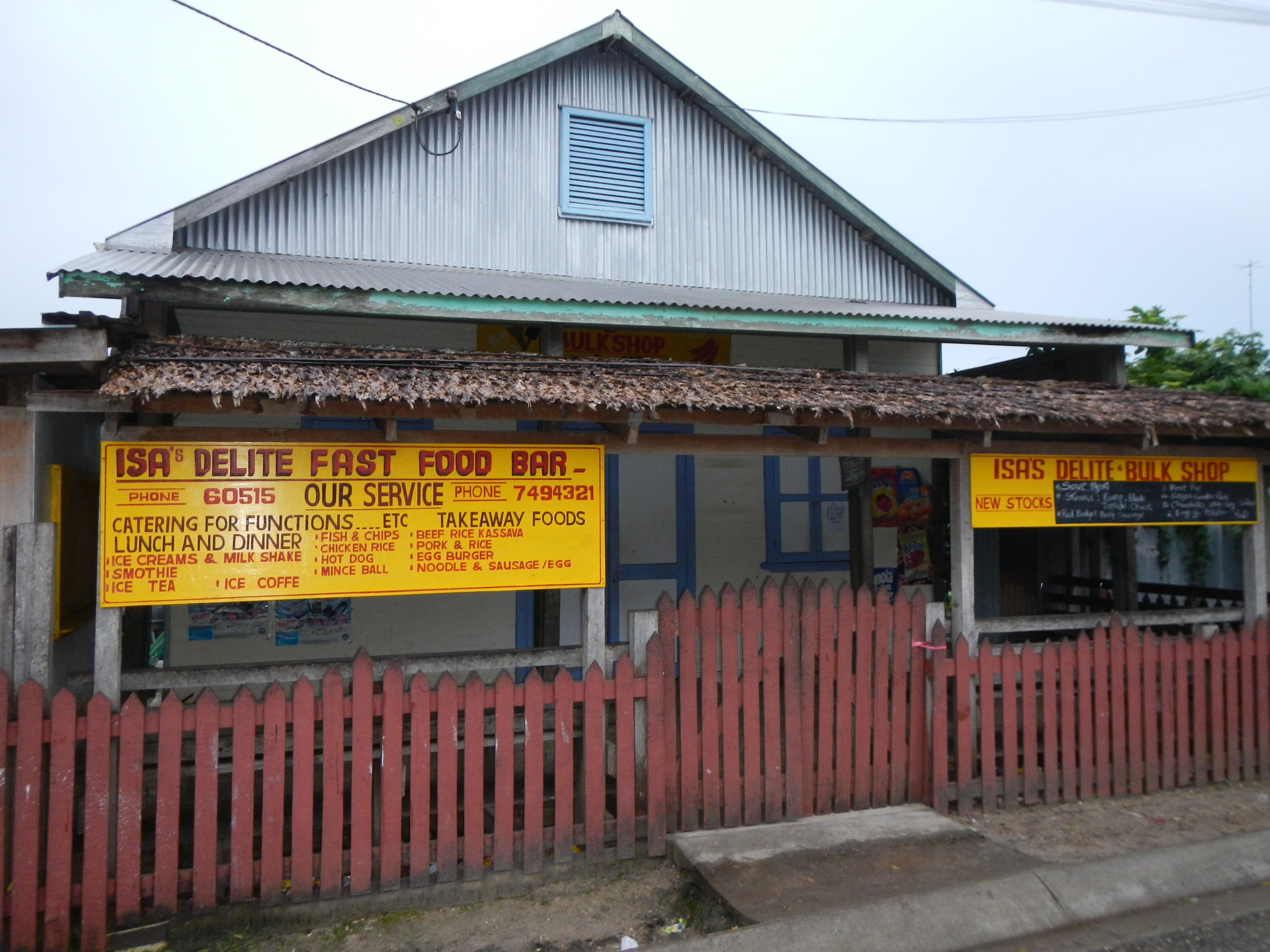
Fast food. It’s everywhere.
The rhetoric surrounding trade policy in the Pacific is that trade agreements will solve all the country’s problems. The country is negotiating four separate sets of negotiations, so that trade policy has come to be synonymous with trade deals rather than building productive capacity, which is the vital missing element in economic growth. The problem isn’t the demand-side; it’s supply. The islands just don’t have much to sell either at home or abroad.
————————-
Given that development economists don’t have laboratories, visiting developing countries is the next best thing, and I don’t think academics do nearly enough of it. So much ‘economics’ consists of cranking the handle on complicated mathematical models in US and European universities rather than actually observing what happens in the real world, that I think a lot of economists end up barking in the wrong forest, never mind up the wrong tree. Even what passes for empiricism usually amounts to statistical manipulation, often using unreliable data.
Many of the criticisms of mainstream economics (mine included) revolve around its alleged ideological nature: it preaches free-market solutions because it supports prevailing relations of production. But to some extent the problems with mainstream economics also result from its lack of genuine empiricism, by which I mean case-studies achieved through immersion in local culture and economic circumstance. Economists just don’t bother going to developing countries and finding out what happens. They’re so content to sit at their desks doing maths that they remain ignorant of the way the world really works. And in the Solomon Islands, that means that a quarter of people live in poverty; that kids only go to school for an average of 4.5 years; and that 36 out of every 1,000 children won’t see their fifth birthday. Those bland numbers represent injustice, the kind of injustice that has to be experienced first-hand.
Seems a bit harsh, but then maybe he just didn’t like her any more. Two others were executed, members of the Unhasu Orchestra and the Wangjaesan Light Music Band. The trio were accused of videotaping themselves having sex and selling the videos.
“They were executed with machine guns while the key members of the Unhasu Orchestra, Wangjaesan Light Band and Moranbong Band as well as the families of the victims looked on,” reports South Korea’s Chosun Ilbo.
 Far from being machine-gunned to death in front of your friends, in lots of countries videoing yourself having sex is a ticket to stardom.
It’d be funny if it weren’t so paranoid
I’m not sure what’s funniest about the following cartoon published in the Singapore Straits Times: its wrong-headedness or its paranoia. Singapore is the world’s fourth-richest country measured by per capita GDP in purchasing power terms.

The common weal
Today I went to an event at the Edinburgh Fringe festival on the common weal, an initiative launched by the Jimmy Reid Foundation, a left-leaning think tank which among other things campaigns for a more equal and fair independent Scotland.
Director Robin McAlpine defined the idea of the common weal. The phrase comes from the old Scots term which means both ‘shared wealth’ and ‘our wellbeing is common to us all’. In essence it means that if we share more we will grow the sum of wealth and wellbeing available to everyone. Put differently, both society and individuals will benefit if we emphasise mutuality and equity rather than conflict and inequality.
James Meadway from the New Economics Foundation spoke passionately about the inequalities at the heart of the UK economy and why Scottish independence is essential for geographic income redistribution — and as a beacon of hope for England.
Lesley Riddoch, the third presenter, has written a new book, Blossom, suggesting that Scotland can learn from Scandinavian local democracy.
According to Riddoch Scottish councils are too big. The average Norwegian municipality has 12,500 people – the average Scottish council serves 162,500. Councils have been robbed of their power, and as a result most of us feel powerless. Apathy is a result of institutional failure rather than an inbuilt problem with national consciousness.
In response to McAlpine’s proposal for a national investment bank Riddoch said that Scotland should have fewer national entities; we need small, co-operative organisations which answer to local demands. Councils cover such large areas they’ve become out-of-touch.
I agree but I think it’s naïve to imagine that local councils can have anything close to enough power necessary to counteract the demands of international companies. If the British state struggles to generate enough tax revenues from footloose multinationals that hide their cash in international tax havens, then local councils will certainly find the task a lot harder.
The annual council budget of East Lothian, where I grew up, is £220 million. That’s chickenfeed to big corporations. The British financial sector alone spent almost half this sum lobbying the government in 2011. US lobbyists spend many multiples more. How could a small council withstand such sheer financial muscle?
Some government functions can only be delivered on a large scale. The well-known problems of the global economy — low wages, a race to the bottom on tax, environmental degradation, financial instability – are partly a result of the lack of international cooperation and a breakdown in national state regulation.
These failures affect local communities. The apathy felt by many Scots isn’t just due to the erosion of local democracy; it’s the result of the anarchy of the global economy. That the admirable local opposition to Donald Trump’s Aberdeen golf course hasn’t translated into widespread rage is partly due to the feeling that our actions amount to little against the clout of transatlantic millionaires.
The Tobin tax is a good example of the need for powerful large-scale governance. If a single country decides to tax international capital flows, even by the tiny amount proposed under the Robin Hood tax campaign, financial institutions will have an incentive to move elsewhere to a region or country without such a tax. Any similar threat by national or local governments risks failure if it isn’t conducted in unison with other powerful states or regions with the teeth to make their rules stick.
The radical environmental regulation needed to preserve our planet will never be put in place without better international governance – which in turn requires strong national control. For instance countries or localities that tax air transport more will simply lose out to airports with smaller levies. Carbon emissions are everybody’s problem, so they need the input and coordination of all.
Public goods and natural monopolies can’t be delivered without a strong state. The failings of privatised utilities are due to a purposeful erosion of the power of the national state rather than its inherent failings. Rail, the post, electricity, power and water need to be brought back under local and national control.
Scandinavian countries are in fact exemplars of the strong state — they tax and spend, and they consciously retain the levers of economic control so that they can allow their citizens to exert democratic influence. For instance Denmark and Sweden stayed out of the eurozone because they knew it would clip their fiscal and monetary wings. Norway isn’t even in the European Union.
I’m not opposed to Riddoch’s view that local governance needs to improve. Doubtless we need to regain control of our communities, and in so doing we will no doubt feel more empowered. But local democracy isn’t inimical to large-scale governance. Certain things need to be done by national states: at least financial regulation, the collection of certain taxes, environmental legislation and the provision of public goods an natural monopolies. Some other things need to be run locally: taxes, environmental services, local transport, possibly health and education.
Maybe there’s no conflict between the local and the national. The real question is whether the institutions of governance and democracy serve to hand more influence back to us, the people, rather than surrender it to the faceless forces of international power. Maybe we need more democracy at both the local and the national levels.

 Emergent Economics