The naughty economists should swim in the mainstream
So says Paul Krugman, who talks of
an upwelling of frustration on the part of heterodox economists. You see it in Thomas Palley’s complaint about gattopardo economics, which I discussed yesterday; you see it in the demands for a radical change in the economics curriculum, which Simon Wren-Lewis wrote about yesterday.
But Krugman says heterodox critics are wrong to complain that the economics discipline didn’t predict the crisis. Governments failed, he says, because they didn’t listen to economists enough, rather than because mainstream economic advice was wrong.
That’s a bit like saying a flower needs more weedkiller to make it grow. The idea that European or American civil services somehow didn’t feature teams of mainstream macroeconomists beggars belief. Where did those Treasury experts study? The moon?
And where were all those radicals at the Federal Reserve? Alan Greenspan: somehow not mainstream enough? Come on.
What about the heterodox articles that dominated the American Economic Review over the last decade? Ah. They didn’t exist.
Krugman’s diagnosis, that economists didn’t recognise the emergence of shadow banking, is so specific and minor that it makes me wonder whether he’s having some sort of internal credit crisis himself. Surely a thinker with the breadth of knowledge to write so lucidly about US and global political economy can see further than that?
 For the problems of mainstream economics are much deeper and problematic than a simple failure to understand the emergence of hedge funds and other financial players. Even the idea that governments “should” have listened more to saltwater economists is naive. It fails to acknowledge the reality that power and vested interests dictate which kinds of theory gain prominence and influence policy.
Heterodox economists rightly preach pluralism, but a lot of economics is really just ideology. It’s a system of thinking designed to justify relations of production within the current economic order. It’s no coincidence that mainline economics holds as its basic tenets the concepts of individualism, equilibrium and a strict form of rationality, or that it pretends crises don’t happen and that inequality somehow motivates people to work harder. Saying that markets are efficient is a statement of ideology not science. Basing policy on these sort of assumptions helps capitalism persist; it oils the machine.
This neglect of power and interests relates to another major failure of mainstream economics — its neglect of methodology, meaning the approach to knowledge which concerns the selection and application of methods. A pluralistic approach requires a methodological perspective. How do we choose methods? What meta-perspective enables us to evaluate schools of thought? Sheila Dow’s The Methododology of Macroeconomic Thought is a classic. Her Economic Methodology: An Enquiry, is just as good. When I studied political theory the only compulsory course was “Methods and controversies in the history of political thought”. Methods, controversy and history are mostly avoided in economics teaching.
Economics as taught in most universities is laughably universalist. For example it’s ludicrous that of 76,000 papers published in top economics journals between 1985 and 2005, more were about the United States than the entire rest of the world. Economists think they can speak for everyone and that the world behaves in the way they preach in their unrealistic models, but how can economists know, when they’re mostly based in Europe or America and they don’t even study the rest of the world or go there?
I think the big questions that economists should be asking are (a) why global inequality is getting worse and that most people remain poor (which to be fair Krugman himself also claims to prioritise — hence his recent obsession with Thomas Piketty), and (b) why we can’t live as part of nature, rather than exploiting or dominating it. As seen in Krugman’s shadow banking example, far too much of mainstream economics is trivial or overly-technical, focusing on minutiae. This gives the impression that the big problems have been solved and that we’re just tinkering now. This view is far from the truth, and promotes complacency about glaring problems.
One thing about which Krugman is right is the importance of economic history. In the absence of absolute certainty about the outcomes of theory, and in a situation where we are dealing with the economy as an open system, it’s obviously vital to study what happened in the past. As Mark Twain wrote, history may not repeat itself, but it rhymes. Many highly-trained economists know nothing about economic history. A book like John Kenneth Galbraith’s The Great Crash 1929 should be compulsory reading. If it had been, 2007/8 and its aftermath might have been less likely. Economics needs to be far more empiricist — not just by doing more econometrics but by encouraging the use of case studies and immersion in context.
Lastly, Krugman is wrong to marginalise the frustrations of the heterodox as “a sideshow in the larger scheme of things.” The latest call for reform is only one of many.
Steve Keen, as radical a reformer as they come, seems rarely to have been off TV or out of the newspapers over the last year or so, which has no doubt helped generate funding for his Minsky dynamic monetary model. Partly because of his efforts, endogenous money, modern monetary theory and post-Keynesian economics are more prominent. The Bank of England even recently issued a paper accepting the idea of endogenous money, something about which the heterodoxy had been banging on about for decades. The Real World Economics Review and the online open-access World Economic Review have built tens of thousands of subscribers and the RWER blog remains a go-to destination for questioning economists. The Institute for New Economic Thinking is supposed to promote alternative strands of economics (although it is seen as increasingly conservative).
Several big-shot academics have similarly started to question the very essentials of mainstream economics. Mark Blyth of Brown University admits he’s had to rethink some of his basic ideas. John Kay and former Bank of England monetary policy committee member Willem Buiter similarly question the fundamentals. Krugman himself even points out that Larry Summers has accepted the thesis of secular stagnation, the idea that developed capitalist economies might be set to dawdle for years to come rather than roaring back from crisis. These big beasts would have been less likely to rejig their underlying beliefs had it not been for the existence of a readily-available body of heterodox thought developed in opposition to the mainstream.
So Krugman is mistaken when he trivialises the heterodoxy and tells those naughty economists to paddle to the centre. Student and academic dissent has been building gradually over the last decade amidst a wider public questioning of economics. The problem isn’t that we ignored mainstream economists, it’s that we paid them too much attention. Heterodox economists should keep swimming, strongly, wherever they choose.
Breaking the poverty porn habit
I thought this blog by Emily Roenigk was jolly good. “Is it ethical to depict the graphic qualities of a human being to Western audiences for the sole purpose of eliciting an emotional experience and ultimately, money” asks Emily. In short, is it OK to perv at pictures of pictures of starving skinny foreign people?
Ogling the dispossessed misrepresents poverty, says Emily. Poverty isn’t just an individual experience that can be reduced to an image — it’s rooted in social and economic conditions. Poverty porn makes it seem like you can sort out deprivation with handouts when it’s really part of a complex set of circumstances including the behaviour of rich-world consumers and producers. Charity isn’t enough; a change to the system which creates poverty is essential.
Leering at ever-more-grotesque pictures of poor people can actually reduce our understanding of deprivation. Quoting Steve Corbett and Brian Fikkert’s book When Helping Hurts Emily points out that the “helpers” tend to use material words for deprivation whereas the helped defined poverty emotionally or psychologically. The money is only the start of the story; what really matters is quality of life. A lot of foreign-aid-speak harks back to the Victorian idea of the deserving and undeserving poor, as if it’s up to the rich to decide who’s been working hard enough to deserve their gruel and who’s been slacking.
Emily also argues that poverty porn empowers the wrong people. Donors are led to feel as if they can easily fix the problems of the destitute when in reality donors may know very little about the communities which they are targeting. Reducing things to simplistic images also means that the rich can escape looking at their own economic system. Global poverty is a problem of rich-world behaviour (as I say in point number 8 here). We wealthy consumers need low paid workers to make our cheap stuff. We need a huge underclass of unemployed to scare those lucky sweatshop labourers into working hard for poverty-line wages.
Images of defenceless Africans also sap the poor of their humanity, says Emily (let’s not forget that poor people watch TV too). “Poverty porn objectifies its subjects, defining them by their suffering and stripping them of the vital components of all human life – agency, autonomy and unlimited potential. Advertisements and marketing materials depicting the suffering of the poor and soliciting financial support may inadvertently tell subjects that they are indeed helpless beneficiaries, dependent on the support of the wealthy for any lasting transformation.”
Ultimately poverty porn works. It raises more money for charities and donors. But Emily rightly questions whether those fake images are worth the cash they rake in: “if we want to truly transform communities so they are economically and socially just, we have to create avenues for their voices to be heard. We cannot impose our constructs on them.”
23 things they don’t tell you about Ha-Joon Chang
OK, a lot fewer than 23 things, and they probably have told you — but it made a good headline. Ha-Joon Chang’s 23 Things They Don’t Tell You About Capitalism is one of those iconoclastic books that only comes along every few years. I love it when an author reveals conventional wisdom as groupthink. (I’ve always thought that conventional wisdom was an oxymoron anyway). Too much of what passes for economics is just rehashed triviality; piecemeal tinkering in a world in need of radical answers.
Chang’s first point is that there’s no such thing as a free market. The idea that markets are political constructions not independent, everlasting entities, originates in Karl Polanyi. Like a puppet on wires, so-called free markets are secretly conditioned by a million rules and regulations. In the early 1900s employers argued against rules limiting child labour, saying that it would interfere with labour supply. Now we think of those sort of arguments as barbaric. Stock markets, the supposed essence of free-marketism, are highly regulated. Wages are mostly determined by immigration policy rather than markets. British people can only pay themselves a minimum of £6.31 an hour because they exclude the many Indians who would do the job for a tenth as much.
Not only are markets political, but free-market policies rarely make poor countries rich, says Chang. Again it’s been said before (most notably by Chang in Kicking Away the Ladder), but rich countries all protected their own markets in the early days, contrary to the advice they now give to poor countries. Developing countries on average grew faster in the 1960s and 1970s when they pursued statist policies than in the 1980s and 1990s when the free-market Washington Consensus took hold. Chang points out that the United States founding fathers promoted protectionism and that Alexander Hamilton more or less invented the idea of infant-industry protection.
Chang skewers the transparency mantra that pervades development policy with a snapshot of the United States in the 1880s: “Corruption is rampant, with political parties selling government jobs to their financial backers. The country has never recruited a single civil servant through an open, competitive process.”
Another angle to Chang’s argument that markets are built rather than autonomous is his point that capital has a nationality. Theorists of globalisation like to suggest that big companies have no homeland, that they shift their operations across borders to take advantage of new opportunities and costs. But in reality most transnational companies produce the majority of their output at home, especially high-end activities like research and development. Managers feel a moral and legal obligation to their country of origin, it’s hard to move senior employees, and companies may feel more comfortable in their domestic institutional environment.
Some more skewering: Africa isn’t forever burdened by a poor climate, the ‘wrong’ sort of people or ethnic strife. African per capita income in fact grew at about 1.6% a year in the 1960s and 1970s, about the same as Britain’s did when it was first industrialising. During the 1980s and 1990s African per capita income fell by 0.7% per year. If Africans were all lazy and the climate too poor for economic growth, then the continent’s economies would always have been stagnant. Some other explanation must have been responsible. Chang says the policies of free trade and free markets known as structural adjustment primarily explain the catastrophic downturn seen in that era. Better technologies, organisation and institutions can overcome the obstacles of most African countries.
Chang continues with a similarly iconoclastic list of things they don’t tell you. His conclusions are mostly spot-on, particularly that we should stop assuming humans are all rational; that we should put the priorities of poor countries above those of rich ones; and that we should shrink the financial sector.
I’ve always thought of Chang as brilliant but blinkered by the success of his native South Korea. It’s as if he imagines that if every poor country (and a few rich ones) followed similar policies to that of Seoul from the 1970s onwards — high tariffs, picking winners, state-directed investment — everything would be hunky-dory. Paul Mason rightly says that Chang is naive to suggest that making the state bigger will automatically solve all our problems. Troubling questions hang over any return to the statist seventies.
It’s this South Korean triumphalism that presumably underlies Chang’s scepticism about the post-industrial society. South Korea was, after all, nothing if not industrial. One of Chang’s favourite stories is about how the country had never built a ship by the mid-1970s but by the end of the decade was a world leader in the industry. The Chaebol oversaw some of the most remarkable examples of industrial growth in history.
But to suggest that we can’t move beyond the industrial era is to succumb to a terrible pessimism. People who argue that we should keep building more and more things, and, as a corollary consuming those things, don’t seem to recognise that the cycle of manufacturing and consumption has to end somewhere. Poor countries can’t all move into heavy industry like Korea did — otherwise the planet is screwed. Fortunately, greener alternatives exist. Services growth and trade will be vital.
Whilst reading 23 Things you do begin to wonder whether Chang has actually spent time in seriously deprived countries or whether his frame of experience is limited to East Asia and Western Europe. Dozens of countries will never industrialise. They’re too small, too far away from big markets and global trade in physical products has become so liberal that these least developed countries stand no chance of getting on the ladder, never mind it being kicked away. I’m thinking of the many newly-independent or war-stricken African countries, like South Sudan, the Central African Republic and Somalia.
Most of the 60 or so small island or landlocked developing states will have to pursue different development strategies to those of East Asia. Why would you manufacture microchips in the middle of the South Pacific or routers in Bishkek? Services like tourism are the only option for many of these countries — and in contrast to Chang’s pessimism, the Internet presents big opportunities for overcoming physical isolation.
I think political economy should be about two things: how we provide for each other and how we come to recognise that human beings are part of nature rather than imagining themselves to be outside it and hence destroying it. Chang addresses the first but totally ignores the second. This blindness to the importance of sustainability is presumably in part again due to Chang’s South Korean background but it’s also probably got a lot to do with his reformist, Keynesian economics. “Capitalism is the worst economic system except for all the others,” he writes in the conclusion.
Neither of these strands of thought — Keynesianism or East Asian developmentalism — is likely to help us understand the relationship between the current system of economic production and the natural environment, which is surely one of the most important things they should tell you about capitalism. Chang has smashed some banalities and told a compelling story, but his economics could be more forward-looking.
Returning to poverty is a bigger risk than previously understood and policies should be redesigned to tackle extreme deprivation. So says a new report from the Overseas Development Institute.
Unless we directly address extreme deprivation and wealth security, a billion people may still be poor by the year 2030 according to The Chronic Poverty Report, which aims at influencing the next Millennium Development Goals which will establish global development objectives from next year onwards.
Using panel data, which tracks people over time, the report shows that escaping poverty is only the first hurdle; relapsing is a real danger. In rural Kenya and in South Africa, surveys over different time-periods found that 30% to 40% of those who managed to escape poverty fell back, rising to 60% during one recent period in rural Ethiopia, as shown in the following diagram.
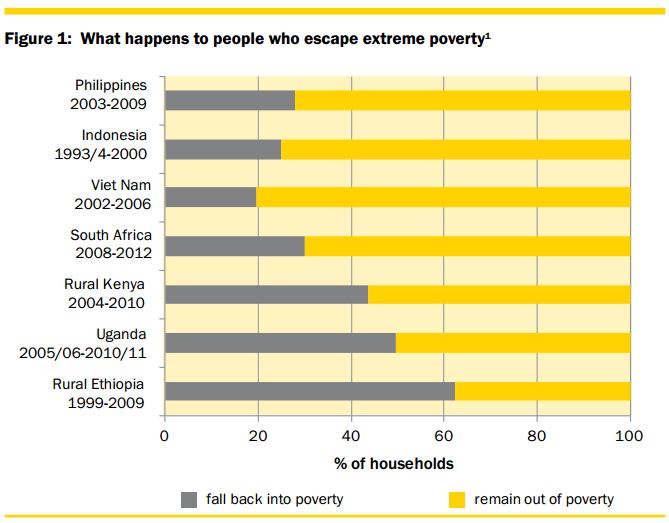
Source: ODI
Supporting permanent escapes from chronic poverty requires far more investment in the education, employment and self-employment opportunities and in the associated infrastructure that allow people to improve their living standards while building their resilience to cope with setbacks and the consequences of climate change. This
includes, for example, disaster-risk management, universal health provision and social protection.
The report points out that the answers will vary between countries but that several policy generalisations can be made. In South Asia the poor are often excluded from economic growth. Laws and rights are important. Legislation for minimum wages is proven to work well and should be expanded.
In sub-Saharan Africa:
the development of social assistance (cash transfer) systems is the major policy challenge for the next five years. Countries that have not developed these by 2020 will have very little chance of getting close to zero poverty by 2030. It is no accident that Ethiopia, with its Productive Safety Nets Programme, is among the countries seen as making progress.
The ODI also says that higher domestic tax revenues are needed given that most governments don’t spend much on the deprived. This is in opposition to the standard view of the past two decades which said that shrinking government spending would reduce poverty by promoting market forces. International aid can also support the reduction of chronic poverty.
The study supports the view that insecurity may be a bigger problem than simple lack of income. Poverty is multi-dimensional, consisting of at least access to resources, power and gender imbalances. Inequality and insecurity in a middle-income country can feel almost as bad as extreme deprivation in a country with very little wealth.
Poverty dynamics have been somewhat neglected until now, meaning that many donors and governments believed that once they had helped the underprivileged escape poverty, their job was done. The study shows that without health, education and opportunities, the risk of relapse is very real.
Another thing they don’t tell you about poverty
Chloe Safier (@chloelenas) pointed out that my list of 21 things they never tell you about poor countries didn’t pay enough attention to gender. She was kind enough to send me some comments. One of the problems with the way we talk about the majority world is that we see the poor as an undifferentiated mass.
Here are some of her main points (I hope I don’t do Chloe an injustice by paraphrasing in places — her full comments are more illuminating and nuanced):
- As Duncan Green of Oxfam says, “gender is undoubtedly one of the world’s great faultlines of distribution and injustice”. Women make up 70% of the world’s poor and usually earn less than men.
- The discipline of economics tends to ignore the kind of work that women do, which is often unpaid. The economic statistics don’t disaggregate according to gender. Economics is very masculine. It’s rare to find a economic development models that includes work outside of the traditional market space. When gender issues are considered in the context of economics, it’s often done in a way that sees women’s rights as a means to achieving economic growth rather than goals in themselves. As noted in a recent report from UN Women, “economic growth alone does not promote gender equality.”
- The global economic system depends on women to perform care work without cost: caring for the sick, household chores, informal education, childcare.
- Gender inequality limits economic growth. A recent study found that “increasing the levels of female employment could help raise GDP by 5% in the United States; 9% in Brazil; 9% in Japan; 11% in Italy; 12% in the United Arab Emirates, and 27% in India.”
- Women are often unable to inherit land due to restrictive laws, reducing the efficiency of the economic system and feeding our misperception that the world is ‘full up’ and that we are unable to provide enough for everyone.
- In contrast to the above two points, some feminist economists say that we shouldn’t be pushing for women to take part in the paid labour market if it’s inevitably going to lead to exploitation. If men are unhappy in their jobs, we shouldn’t push for unhappy jobs for women. We need a more just and humanised economy that doesn’t rely on marginalizing some for the profit of others.
- Economic development and aid work should be much better at dealing with gender. According to Sylvia Chant of the London School of Economics “there is still no international database which provides a breakdown of the incidence of women’s monetary poverty in comparison with men’s.”
- Chloe adds a final point: “When we ignore the complex ways that individual and communal identities can impact poor people’s lives, we miss some of the driving factors of poverty and we miss an opportunity to redress the (gendered and other) inequalities that are keeping people poor, voiceless, and without rights.”
Responses to 21 things
My last post, 21 things they never tell you about poverty, was by far my most-read yet, receiving about 10,000 views in two days. Clearly it struck a chord. I wonder whether there’s a widespread feeling that we sort-of think we’re doing things about poverty but that something is missing? Charities constantly harangue us, but poverty persists. The international media focus relentlessly on events in the rich world, encouraging us to think that is the world, but occasionally shows pictures of deprivation — which are portrayed as the exception, and the fault of poor countries themselves, separate from our actions. Certain less well-off parts of the world are synonymous with chaos and underperformance. Nothing happy ever happens there. Could it be that the causes of poverty are deeper than we think, and that, God forbid, the economic system might even be the problem — even for us in the rich world? Periodic hand-outs might not cut it.
What was interesting was to see how the post spread: at first someone in Croatia must have posted it on Facebook, because it became big in the Balkans, then during the American daytime someone put it on Reddit, which sent the most links. Twitter, surprisingly, provided a small proportion of hits. As always most views came from the United States, followed by the UK. Feedback was via Reddit, Facebook, Twitter and email, which is a bit of a shame because it meant that the discussion wasn’t in the same place. Of course for the reasons stated in point 1 most feedback wasn’t from the countries that the post itself discussed (and because it was in English!)
Anyway, enough navel-gazing. What were people’s main responses? Mostly they were very positive, which is encouraging.
One person criticised points 1 and 2 on the grounds that he or she “already knew it all”. Fair enough. Someone else thought i’d made a statement of the obvious, saying that it’s self-evident that more poor people live in Asia than in Africa because Asia is much bigger. But that’s not the narrative we’re taught. I don’t think people have woken up to the progress that’s been made in Africa or the growing differences within and between countries. Everything on telly about Asia is about the rise of China and the Oriental miracle, and how these high-tech superstates are going to run the world. Maybe, but first they have to sort out their glaring and growing problems of inequality.
Surprisingly no-one criticised point 6: “Our main tool for understanding poor countries – mainstream economics – is woefully inadequate and all about the rich world.” That’s a controversial statement, and one which i’d have thought some economist out there would have issues with. But perhaps most people nowadays just regard economists as close to a nasty thing you might step on in the gutter.
A more cogent criticism was that it’s naive of me to write that “the governments of poor countries should be more adventurous, leapfrogging ideologies. Environmental sustainability and a focus on happiness could enable some countries to prioritise the important things in life.” The objection was that in reality the marginalised countries don’t really have the autonomy to be able to pursue their own policy objectives.
But I think that’s an excessively cynical view, put about by those who imagine the world economy is a machine rather than a collection of human interactions. Governments and people all have the potential to influence the direction of the societies within which they live. Other narratives are possible — I cited the example of Gross National Happiness in Bhutan, which really works. I know because i’ve seen the policy in action. One of the incredible achievements of Cuba is to pursue a somewhat different economic system despite the United States embargo. It’d be like the UK being prevented from trade with Europe (something which politicians honestly seem to be considering, but that’s another story).
There was some criticism of the point that the world isn’t overpopulated. Again I suspect that overpopulation has become a standard trope, one which is easy to understand. But the world isn’t full up, and nor do we remotely use resources efficiently. Saying the world is overpopulated is a good way of excusing the rich world its voracious over-consumption and of absolving those 85 billionaires of their inexcusable affluence. Effective distribution is the challenge, not the birth rate. In any case high birth rates are partly a product of poverty. In all rich countries people stop having so many babies after a certain level of income. Lowering infant mortality actually reduces population growth, as this very clear video by Hans Rosling shows.
Someone expressed scepticism about point 16, which is that most countries which successfully reduced poverty didn’t directly try to reduce poverty. Others thought it was one of the better points. It’s based on the experience of the East Asian tigers, where there were no Millennium Development Goals on poverty, environmental sustainability or global partnerships for development. One of the most-ignored aspects of East Asian economic development was the sheer ability of governments to accumulate and mobilise capital and to direct it into productive areas. Health and education were certainly prioritised in some countries, but largely as a means of facilitating improvement of the stock of human capital rather than as ends in themselves. If people were sick or didn’t have good enough skills they wouldn’t be as useful. Poverty reduction in many cases came as a result of the economic boom, without direct policies aiming at reducing deprivation. After all, most Asian countries don’t even have social security. The point wasn’t to suggest that in future all countries that want to reduce poverty should initially ignore the poor, or even that they should be as brutal or utilitarian as the Asian tigers or China. They shouldn’t. But for the international development community to exclusively promote social goals at the expense of economic ends means that countries may not develop the government revenues to be able to spend enough money on education, health and social security themselves, and that development isn’t self-sustaining.
I think number 17, how rich countries behave is often more important than how much they spend on aid, is really important. I could have added the well-known point about US and European agricultural subsidies. Cotton subsidies for US farmers, in the order of billions of dollars, directly put West African producers out of business (and others, such as in Brazil). The European Union spends around 40 billion euros a year on direct subsidies. Agricultural and fisheries subsidies form over 40% of the EU budget. Many years ago Oxfam famously calculated that in effect each European cow receives a handout worth $2.20 a day, over twice the income of the bottom billion of the world’s people.
In the comments underneath the blog Jonathan Said questioned point 18. “Just give them the f-ing money”. He rightly said that cash transfers aren’t the solution to poverty reduction. I should have been clearer. They play a small role but they’re particularly helpful because they mean that money is channelled straight to the poor without the intermediary of the charity manager or the aid bureaucrat. Aid is, or should be, a form of redistribution. The less it is just a tool of politics or patronage, the better.
There is a misperception that all aid breeds dependency and that countries should be left to develop under their own steam. This is wrong. Some aid can be problematic if it replaces funds that would have come from elsewhere, but lots of aid is the only game in town. It doesn’t ‘crowd-out’ private investment. European governments and charities are getting better at designing aid programmes, and ‘leaving countries to develop under their own steam’ really means abandoning them.
One of the worst books about development i’ve read is Dambisa Moyo’s Dead Aid. Bill Gates recently called it “evil”. Moyo presents a picture where vast oceans of aid are being squandered and stolen. In reality global aid is much smaller than she states (ridiculously, she counts only gross aid to Africa, not net — lenders receive large sums in interest payments on development loans) and aid has had a tremendous effect. Gates points out that it’s immoral to deny children live-saving medicines and vaccines, and that aid has saved hundreds of millions of lives over past decades, not to mention supported economic growth.
21 things they never tell you about poor countries
Prompted by Bill Gates’s annual letter and the response from the Overseas Development Institute I thought I’d list some of the things that in my experience seem to be less understood about poor countries. (I wanted to list 23 things like Ha-Joon Chang on capitalism but I couldn’t think of another two). I use the word poor on purpose because although the word risks sounding patronising or dismissive, euphemisms like developing and less-developed can be worse. Thoughts are welcome.
1. Poverty is the rule, not the exception. For most people life just isn’t as good as it is for you and I, the comfortable people from a country rich enough to allow us the literacy, time and Internet access to read blogs written by well-meaning left liberals. Poverty-as-rule-not -exception is difficult to bend our minds around because we tend to base our views about the world on direct experience. If people around us seem mostly well-fed and content, then why shouldn’t everybody else be?
Although things are improving, a huge chunk of the world’s population remain poor. Nearly a fifth of humans, 1.29 billion, are considered extremely poor . In effect the equivalent of every man, woman and child in Europe, the United States and the Middle East scrape by on 75 British pence a day adjusted for the cost of living in each country. About a third of the world lives on less than $2 a day. The poorest half of the world – 3.5 billion people – own only 0.71% of the world’s wealth between them.
A billion people live in chronic hunger. Nearly a third of all children are chronically malnourished, which unless addressed before the age of two often leaves them stunted and mentally impaired. A sixth of the world’s adults can’t read or write and many more have only rudimentary literacy. Sub-Saharan Africa has only two doctors for every 10,000 people, which is partly why on average its inhabitants live to an average age of 56.
Rather than a term like “developing” to describe these people and countries, the travel writer Dervla Murphy’s phrase “majority world” is more accurate.
2. Most countries aren’t well-off. The following graph using World Bank data shows that most countries have a relatively low level of national income per capita. 120 nations earn less per person than the world average. When you reach an income per capita of about US$20,000, about half that of the UK, there’s a big jump. Bermudan national income per person is US$104,590, 455 times that of the Democratic Republic of the Congo.
National income per capita, US$

[NB. Not all country labels fit on the vertical graph.]
3. More poor people live in Asia than in Africa. Everybody seems to be wittering on about the Asian Century these days – and Asian development has been miraculous. But about 69% of Indians live on less than US$2 per day: 850 million people. A third of Chinese, 400 million, remain similarly poor despite the country’s amazing success in reducing poverty. Together those two countries contain more poor people than there are Africans.
4. The distinction between “developed” and “developing” countries is meaningless. What’s Brazil got to do with Liberia? Not much, apart from an Atlantic coast. One is a newly-industrialising behemoth with an average income near the world average. The other is one of the world’s poorest, emerging from war. Yet both are officially considered developing. China, Turkey, Russia, Indonesia, Mexico and India are all big and relatively dynamic even if they also contain a lot of poor people. Millions of people in those countries live just like Europeans, and the emergence of these nations is one of the biggest reasons why poverty will continue to drop in the coming decades. Yet plenty countries also called developing are being left behind. I count 41 supposedly developing nations which in 2012 on some criterion had real incomes that were lower than a decade earlier. They’re probably better described as undeveloping.
5. Lying on the beach in Thailand or Gambia doesn’t tell you much about poverty. We still don’t know as much as we should about poverty and we try to ignore poor people. Most people’s experience of the global poor is the waiter at their table or the pool attendant, the ones lucky enough to have jobs. Only by direct experience and immersion in local circumstances is it possible to have a vague inkling of what it might be like to be genuinely destitute. There’s no obligation on holidaymakers to go wandering around in slums, but anybody who claims knowledge about deprivation should experience or observe it first-hand for themselves, ideally for a long time.
6. Our main tool for understanding poor countries – mainstream economics – is woefully inadequate and all about the rich world. A sample of 76,000 economics journal articles published between 1985 and 2005 shows that more papers were published about the United States than on Europe, Asia, Latin America, the Middle East and Africa combined. Like I said in this blog post, that’s as ridiculous as if biologists researched only flowers, or physicists only outer space. It’s no wonder that the mainstream model of human beings bears no resemblance to most people on the planet. Economists start from the assumption that humans are individualistic, utility-maximising and strictly rational in a narrow sense. Actually many people are communitarian, social, non-calculating, uncertain about the future and often act according to sentiment or whim. Mainstream economics allows no theory of power or politics and can’t see the world economy as a system.
7. The economic statistics on poor countries are awful. Which undermines my first four points. As Morten Jerven says in his book Poor Numbers: How We Are Misled By African Development Statistics And What To Do About It, “the most basic metric of development, GDP, should not be treated as an objective number but rather as a number that is a product of a process in which a range of arbitrary and controversial assumptions are made.” Jerven finds that the discrepancy between different GDP estimates is up to a half in some cases. This supports my experience from working in the least developed countries, where statistics offices are usually underfunded and don’t have the resources to collect data often or well enough.
There’s a kind of false scientism: foreign academic economists spend ages refining complicated econometric models despite the raw material being rubbish. In the absence of good numbers, the only immediate alternative is to live in a country, to use good theory and to rely where necessary on case studies and even anecdote.
8. We need somewhere to make our T-shirts. The global development story is all about how wonderful it would be if we could end poverty. But the current economic system relies on cheapness. Capitalism functions partly via its ability to maintain low wages. Why has global inflation been so low over the past decade or more? Partly, the China effect, whereby the opening up of huge untapped labour markets meant that whole Western industries could outsource their manufacturing and that new local manufacturers could emerge. China’s rural poor keep Foxconn workers on their toes – if you don’t like assembling iPhones at US$18 for a 10-hour day (much higher than it used to be) 1000 people are waiting to take your place.
Nairobi’s Kibera slum-dwellers and rural poor keep wages low by functioning as a reserve army of labour willing to work for peanuts. In Haiti garment manufacturers recently argued that a minimum wage rise to the equivalent of five dollars a day would kill their business. Wikileaks published documents showing that the United States government earlier fought to cap daily pay at three dollars. The country’s only major export industry is clothing destined for the United States.
It’d be worth paying a lot more for our t-shirts if it meant that the people who made them had decent lives. An increase in demand via higher wages would support economic growth. But it’s also naïve to think that western consumers would pay much more for their t-shirts or that businesses would tolerate big wage hikes.
9. Inequality matters at least as much as poverty. A report from Oxfam last month pointed out that 85 people, about as many as would fit on a double-decker bus, own as much wealth as the bottom half of the world’s population.
The Spirit Level by Kate Pickett and Richard Wilkinson shows that equality is good for everyone. Redistribution reduces poverty and makes life better for the rich in the form of less crime, better education and a more cohesive society. Global inequality is getting worse, not better. If we don’t radically reduce inequality the poor will eat us, so aid isn’t an option, and it’s not about the rich world “saving” the poor. It’s essential for everyone.
10. Africa isn’t a country. Although sub-Saharan Africa’s economy is still much smaller than Britain’s, some Africans are fat, go to the supermarket and drive cars. Many are very poor. The rise of the African middle class is one of the most under-reported stories of our times. If people in the UK think about the continent at all they think of the Ethiopian famine of the 1980s. Partly this is the fault of the major news media, which have cut back on foreign coverage so much that all they report on is Big Events – a bomb, a famine, a war. Reporters who occasionally fly in from abroad miss the cumulative series of small happenings that amount to a trend. To show only negative TV stories about Africa smears the whole continent. The Central African Republic isn’t Botswana, which isn’t Namibia. Within countries the divide between urban and rural populations is increasingly stark.
11. Not all poor countries are corrupt. Corruption tends to be more obvious in some poor countries because the police aren’t very good, the rule of law isn’t established and small-scale bribery may have become entrenched, but a country isn’t necessarily poor because the wealth has all been stolen. All sorts of other more important reasons explain poverty, like political instability, bad economic policy, colonial history, an over-reliance on tropical commodities, distance from major markets, being landlocked and poor health and education.
Relatively uncorrupt poor countries I’ve worked in or on include Vanuatu, Fiji, Kiribati, Tuvalu, Samoa, Tonga, the Federated States of Micronesia, Bhutan, Cape Verde and Mauritius. Arguably a good hundred others are less corrupt than when the United States or Britain were industrialising.
In the UK until the early 1800s it was perfectly normal for ministers to ‘borrow’ their departmental funds for personal profit. Until 1870, appointments of high-ranking civil servants in Britain were made on the basis of patronage rather than merit. The British government chief whip was actually called the patronage secretary of the Treasury because distributing patronage was his main job. (h/t M. Ibrahim) This was at a time when Britain became the first superpower.
Arguably the banking industry and its takeover of American and European governments represents a far bigger and more dangerous form of corruption than even the bribery and political theft that blights the likes of Nigeria. In the US and UK lobbying is a multi-billion dollar business which subverts the democratic process. From 2008 onwards , encouraged by lobbyists, the UK government committed to spending a staggering trillion pounds on the bank bailout, which is about ten years’ worth of National Health Service funding. It wasn’t as obvious as baksheesh but it amounted to the same thing only on a vastly larger scale. One academic estimates that by the end of 2012 the UK bailout had cost the taxpayer up to 13% of one year’s economic production.
Corruption doesn’t necessarily cause poverty: that’s like blaming poor countries for their own failures. In some cases quite the reverse can be true. Some people argue that corruption has helped national politicians align their interests with that of their country. Indonesia’s President Suharto understood that if he generated wealth there’d be more to steal, so he installed a team of technocrats whose sole job it was to grow the economy; immoral but effective.
12. Money doesn’t make you happy. Up to about US$75,000 a year it does – and most people aren’t anywhere near that level – but beyond that it doesn’t have any effect, according to Nobel prize-winning psychologist Daniel Kahneman. “The four basic needs: food, housing, clothes and medicine must be cheap and easy for everybody. That’s civilisation”, says Jon Jandai, a farmer from northeast Thailand. I’d add primary, secondary and tertiary education, too.
13. Poor countries can learn from the mistakes of the rich on the environment and life satisfaction. Lower income countries have leapfrogged some technologies. For example many will never install fixed telephone lines because mobile coverage is so good. Vast numbers of people will never touch a PC, doing all their computing on a smartphone or tablet.
The governments of poor countries should be more adventurous, leapfrogging ideologies too. Some proponents of economic growth argue that environmental sustainability and a focus on happiness will handicap poverty reduction. But it could enable some countries to prioritise the important things in life. Endless growth is impossible and undesirable.
Beyond a certain point rich inefficiency is the real problem. Why do developing countries ape the development paths and economic structures of the West? We are wage slaves who perform bullshit jobs so that we can service our mortgages. The advance of the car ruined everyone’s quality of life so that a minority can sit in air-conditioned metal boxes in jams. Clever though-leadership in the majority world could lead the way for the rich. Bhutan’s idea of Gross National Happiness is an example.
14. The world isn’t overpopulated. There’s plenty of food to go round. World agriculture produces 17% more calories per person today than it did 30 years ago despite a 70% population increase, due to rising yields, higher farming intensity and more use of land. The real problems are the system of distribution and energy use. If the rich world didn’t hog all the food and produce it inefficiently there’d be enough for everyone.
15. Governments often do things better than markets. Market fundamentalism is the new global creed, and yet most countries that developed successfully did it initially via heavy government intervention. Markets suffer from serious coordination failure. The global free-flow of capital and trade renders poor countries more vulnerable. As the United Kingdom has proven, natural monopolies like the railways, post office and water and electricity utilities are better off in public ownership. In poorer countries the case for government ownership is even stronger.
16. Most countries that successfully reduced poverty didn’t directly try to reduce poverty. They aimed at economic transformation. A fall in poverty was an indirect result of an increase in productive capacity. Investment rates and capital accumulation were high and aimed at enterprise development and technological improvement, as well as structural change toward developing the non-traditional sectors, including linkages to agriculture and the wider economy.
This sort of obliquity is what John Kay talks about in his book of the same name. If you try to target things directly you often fail.
17. How rich countries behave is often more important than how much they spend on aid. The 2008 global economic crisis, which was caused largely by the financial sector, increased poverty for hundreds of millions of people. The collapse in international trade hurt all countries, developing and industrialised. But while the big and emerging nations might recover, the poorest couldn’t cope. A downturn in exports can be life-and-death. When European orders stopped coming, Kenyan flower farm workers simply sat idle. Foreign investment inflows also dwindled. There is a large group at the global periphery which won’t rebound for a long time — and for many people, it is already too late.
Nicholas Shaxson’s excellent book Treasure Islands suggests that Transparency International’s corruption perceptions index has things the wrong way round: we should rank countries on banking secrecy, not graft. The real economic issue is that rich nations harbour ill-gotten spoils, not that Charles Taylor foists himself on Liberia.
18. Just give them the f-ing money, as Bob Geldof sort-of said. Daily Mail readers seem to think that the world has already given enough aid, but in reality an enormous amount remains to be done, as should be clear from points 1 and 9. More aid should be in the form grants rather than loans. Cash transfers are the best way of delivering some help. For example the British Department for International Development works with Unicef and the Kenyan Government in Korogocho, Nairobi, to improve the lives of orphans and vulnerable children through a cash transfer scheme which gives very poor families 3000 Kenyan shillings (about £25) every two months for help with basic household expenses. It cuts out the middleman and it’s been proven through robust testing to reduce poverty, hunger and inequality.
19. Rich countries don’t spend much on aid. The amount officially spent on each poor person globally is US$20 a year, according to the World Bank. The amount has doubled in the last decade following a dip in the late 1990s. But several opinion polls show that rich country inhabitants think they’re much more generous than they really are. Americans think that their government spends 28% of the budget on aid when it’s really about 1%. Brits are almost as bad. The result of this widespread overestimation of generosity is that many people in rich countries want to cut aid.
20. Aid works: both developmental and humanitarian. It’s not widely known that development aid was instrumental in supporting the growth of Singapore, one of the world’s most remarkable economic success stories. The United Nations Development Programme contributed 744 technical assistants from 1950 onwards and spent US$27 million on development help. In 1960 a visiting UNDP team led by Dutchman Dr Albert Winsemius, who became a trusted adviser to Lee Kuan Yew until the 1980s, wrote a report entitled “A proposed industrialisation programme for the State of Singapore”. This document formed the basis of early development strategy. Other major aid recipients that now receive very little include Botswana, Morocco, Brazil, Mexico, Chile, Costa Rica, Peru, Thailand, Mauritius and Malaysia. Bill Gates reckons that through a combination of aid and spontaneous economic development there won’t be any very poor people left by 2035.
He calculates that 100 million deaths have been avoided since the drop in child mortality since 1980, the start of the “Child Survival Revolution” that made vaccines and oral rehydration therapy much more widespread. Total aid, $500 billion, counts money for vaccines, HIV/AIDS, family planning, and water and sanitation from all donors. That works out at US$5000 per life saved, which he rightly says is quite cheap. Hundreds of millions of people have been immunized against Polio, treated for TB and given anti-retroviral treatment for HIV/AIDS.
21. Charity sometimes isn’t the best way of tackling poverty. Sometimes it is. Just because a service is provided freely or from donations doesn’t mean it is better. Often governments are better-placed to deliver assistance because they have better expertise, economies of scale and political access. Taxation places a similar burden on everyone and makes aid revenues more predictable. Sometimes, though, charities have better access and niche skills. Volunteer organisations often have a long history in certain locations and they can avoid accusations of political interference.
Osborne’s sandpit politics will backfire
 As usual the Daily Mash says it better than the mainstream media. “Independent Scotland will not be allowed to use British oxygen” reads one of today’s headlines, written after George Osborne ruled out a currency union with Scotland.
Because that’s what his announcement amounts to: a childish confrontation based on the politics of the sandpit. If you want to play it your way, you’re not getting our toys.
The Chancellor’s gambit will backfire because most Scots can’t stand Osborne and they won’t like being pushed around. The Spectator says that the fact that the government is playing its ace card now shows how worried it is about the referendum result.
Opinion polls continually show a minority in favour of self-rule because many Scots are either scared or apathetic. But the widespread dislike of Conservatism north of the border might translate into action if people feel they are being pushed around too much. Osborne would probably do better not to antagonise the undecided.
Nicola Sturgeon is right to say that if the Tories rule out a currency union then Scots aren’t obliged to take on their share of British debt. Given that the pound is partly Scottish property, if they’re denied the right to use it why should Scots feel obliged to burden themselves with its associated liabilities ?
She’s also correct that it isn’t the Chancellor’s place to rule out a currency union. Parliament will vote on the issue, and they’re likely to think carefully before cutting ties with England’s biggest export market.
It’s not often I agree with the right-wing Adam Smith Institute, but they’re correct that Scotland should use the pound anyway, even if Osborne says otherwise. Plenty of countries use the US dollar without asking the permission of Washington.
The euro’s a no-no. A Scots pound would cost too much, and investors in Scottish debt would demand higher interest rates in an untested currency. Public spending would have to be lower than in the rest of the UK despite the SNP’s social-spending ambitions.
Until now the independence debate mostly seemed civilised and demure — even at times inconsequential. It’s just turned nasty, and Osborne may live to regret delivering the latest volley.
The following is based on a talk I gave with Devpacific last Thursday in Vanuatu.

The chair Odo Tevi, former Reserve Bank governor, looks interested in the discussion while I stare vacantly at my computer
In a passage from his famous work The General Theory of Employment, Interest and Money, John Maynard Keynes presented a novel theory of how share prices are determined. Normally economists like to think of stock prices settling at an equilibrium level where supply and demand meet. The cost of shares is a fundamental property based on the present discounted value of a company’s future worth.
But Keynes thought otherwise, likening stock market investment to a newspaper beauty competition in which the winner is the person who predicts the most popular woman in the contest. Players won’t win by saying who they think is the prettiest; if they’re rational they should try to predict others’ probable choices. Other entrants will, if behaving sensibly, do the same thing, basing their submissions on others’ likely entries.
In the same way stock market investors should base their predictions of future price movements not on what they think a company is fundamentally worth but on the likely behaviour of the crowd. Prices are based on investors’ expectations about other investors’ expectations, resulting in a potentially unstable self-referential situation in which shares can rapidly diverge from their current values. Any notion of a fixed, underlying price becomes wobbly.
Keynes lost and gained a fortune in the stock market, and his concept was later adopted by the investor George Soros, who dubbed it “reflexivity”, claiming to have used the approach to make his billions. A reflexive relation is in essence one in which something affects itself (it’s got nothing to do with Chinese medicine). The difference between reflexivity and reflection is that while the latter suggests looking in a mirror and seeing yourself, the former involves an action deployed on an object and that object reacting back, resulting in a changed situation.
In grammar a reflexive pronoun refers back to the subject of the clause in which it is used. Examples are the words myself, himself, yourself, ourselves. The liar’s paradox – “this statement is false” – is another example. If the statement is false, then whoever said it was telling the truth. But if it is true, then it must be false because the speaker said it was. Therefore if it is true it is false, and if it is false it is true. The self-referential (and somewhat head-bending) nature of the statement has even led some to question the absolute validity of classical logic.
What’s all this got to do with development economics, never mind Vanuatu?
Several social scientists have used the idea of reflexivity in their theories of knowledge and society. In my book, Reflexivity and Development Economics, I try to draw out some of the implications of those theories and apply them to Vanuatu and Singapore.
Anthropologists have been among the most enthusiastic proponents of a reflexive approach. Bronislaw Malinowski in his post-war studies of Melanesian society, it is claimed, “lived as a native among the natives for many months together, conversing with them in their own tongue”.[1] But it became clear that while Malinowski believed he had embedded himself in the society he was studying, in fact he was unable to escape his own preconceived beliefs and cultural tendencies – such as the rather dismissive category “native” itself, a word which would nowadays be considered racist.
Clifford Geertz thought that methodology – the study of methods – is reflexivity, as it involves examining your own project. Geertz argued that anthropologists should explicitly discuss their own backgrounds in order to highlight any biases and predispositions.
The French sociologist Pierre Bourdieu accused Geertz of self-fascination and egotism, suggesting that social theorists should examine not only their own backgrounds but the underlying biases and predispositions of the school of thought within which they operate. Bourdieu questioned the entire notion of objectivity.
The term has been used in a range of other areas including the sociology of scientific knowledge. In physics, the Heisenberg principle states that the objects studied in in quantum mechanics are so small that the instruments used to measure those objects may affect them. Similarly in social science human beings are both the examiners and the objects of examination. A social scientist might not be as neutral and objective as it at first appears because she brings all sorts of baggage into an enquiry.
All social science and policy, including development economics, involves a certain self-reference. We are at once the observers and the observed.
One implication is that economics itself might not be quite as neutral and objective as imagined, and it may be necessary to examine the predispositions and background of development economics and economists.
I argue that reflexivity implies four things:
First, an examination of external values and norms. Do economists bring in certain values an norms to a situation? When might these values and norms be harmful? What kinds of outside knowledge are useful?
Second, an assessment of the importance of local context. The empiricist, bottom-up approach of anthropology holds lessons. Anthropologists tend not to be as deductive as economists, preferring instead to ‘get inside’ a social context and describe it rather than using case studies as evidence to prove a wider, universal truth about human behaviour. Economic analysis should take account of values, behaviour and institutions.
Third, a recognition that economic tools, concepts and policies can undermine themselves, even though they were designed for greater control. Given the failure of most economists to predict the global financial crisis in 2008, the discipline might wish to be a bit more modest. Some of the centrally-held truths of the dismal science proved wrong – like the idea that western economies were undergoing a ‘great moderation’ and that private debt wasn’t a problem. If economists aren’t always correct in developed countries then what are the chances that they’ll get things right in the far-flung corners of the world which receive less attention?
Fourth, reflexivity implies that development economics should allow for theory to be revised if it proves inadequate or as circumstances change. Some of the more successful newly industrialised countries, like Singapore, consciously manipulated the economic environment so as to hold on the levers of policy and direct the economy in desired directions. Policymakers changed the development narrative as they saw fit.
In 1997 Vanuatu was subject to a set of economic reforms known as the Comprehensive Reform Programme. The CRP followed a doctrine known as the Washington Consensus, a list of 10 policies which it was argued would lead to rapid economic development. These policies included current and capital-account liberalisation, privatisation, corporatisation and lowering budget deficits and public spending. An identical programme was carried out at the same time in the Federated States of Micronesia, the Republic of the Northern Mariana Islands, Samoa and the Solomon Islands.
The man who coined the term Washington Consensus, John Williamson, said that “the sooner it wins general acceptance and can be removed from mainstream political debate, the better… The proof may not be quite as conclusive as the proof that the earth is not flat, but it is sufficiently well-established as to give sensible people better things to do with their time than to challenge its veracity”.[2]
The problem was, in Vanuatu the economy almost immediately tanked, performing worse than at any time since independence. The government was obliged to match loans from the Asian Development Bank with spending of its own. When it ran out of money it had to rein in spending, with the result that the economy shrank dramatically. It took nearly a decade for growth to recover its pre-CRP levels. Maybe the proof wasn’t quite so conclusive.
GDP growth, 2000-2015

Source: Ministry of Finance and Economic Management 2012
More worryingly privatisation and corporatisation deprived the government of an estimated VT3.5 billion (US$35 million) in revenue according to the UN, and both the stock of debt and interest payments spiralled higher.
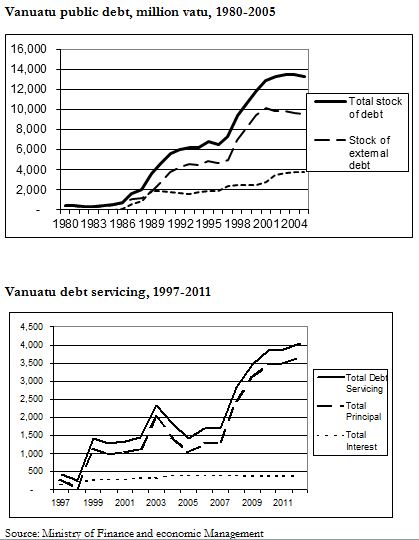
Lots of criticisms have been levelled at the Washington Consensus and the CRP, but I think that the failure of both was partly methodological; that they failed to take due account of context. Some of the norms, the standard procedures of economic policy, were useful, like the need to improve the institutions of government and the purported emphasis on social equity (but about which more could have been done). The use of an outsider-driven policy avoided the need for civil servants to take the blame for difficult decisions. Lessons can always be drawn from other countries.
But broadly the programme failed to take account of context, putting into practice an identical programme in five other Pacific island nations. The CRP ignored special features of Vanuatu society like kastom (traditional society), the use of money and land ownership. All land is held on a leasehold basis and deeply connected with kastom.
The programme also failed to acknowledge the possibility that things could go wrong. Certain parts of the programme backfired. The fiscal situation got worse, not better, and such was the hubris of the CRP that it had no back-up plan to deal with this possibility. Trust in outside agencies fell as some government policymakers became disgruntled. One senior civil servant told me that: “The CRP was a complete waste of time. It paid for the salaries of a few consultants and did nothing for the country.”
The programme also failed to allow for the revision of the development narrative. The government found it difficult to change policy direction. Debt was such a burden that policymakers’ hands were tied. Spending cuts limited the capacity of government. Many local people I spoke to suggest that they weren’t properly consulted. As the ADB’s own assessment of the project stated: “Externally imposed reform measures (conditionalities) that have little government ownership are doomed to certain failure”.[3]
The CRP has long gone and there’s little point in over-analysing the past. But the episode holds lessons for both development economics and future interventions in Vanuatu and elsewhere. Thinking about methodology – how methods are selected and applied – is important when practising development economics. Economists are far too reluctant to question their underlying methodology, preferring to think of the discipline as a standardised approach rather than a toolkit or a process of enquiry using ideas from other social sciences like social and political theory. The discipline probably doesn’t carry the same scientific status as the natural sciences, and it should be a lot more modest.
Reflexivity means in part a process of critical self-examination, involving reflection on outside influences as well as the specific peculiarities of a situation. Maybe development economics itself should become more case-study based, empirical and context-orientated instead of so often applying theories based on deductive modelling?
What’s clear from Vanuatu’s story is that national ownership and carefully-considered forms of consultation are vital. Reforms can’t be designed solely from abroad. One size doesn’t fit all.
[1] Malinowski, B. (1978) Argonauts of the Western Pacific (London: Routledge and Kegan Paul)
[2] Williamson, J. (1993) ‘Democracy and the ‘Washington Consensus’, World Development 21(8): 1330
[3] Knapman, B. and C. D. Saldanha (1999) Reforms in the Pacific, An Assessment of the ADB’s Assistance for Reform Programmes in the Pacific (Manila: Asian Development Bank), p.169
The parochialism of economics
What if biologists researched only flowers, or physicists only outer space? It’d be ridiculous.
Something akin to this kind of single-issue madness operates in the economics profession. The Economist reports that economics journals focus almost exclusively on the United States.
A sample of 76,000 papers published between 1985 and 2005 shows that were more papers about the United States than on Europe, Asia, Latin America, the Middle East and Africa combined (as the Economist’s chart shows below). The imbalance is even more marked for the top five economics journals.
Academic economists almost totally ignore the poorest countries. In the 20 years concerned, only four papers were written about Burundi. The American Economic Review, the fulcrum of academic desire, published one paper on India every two years.
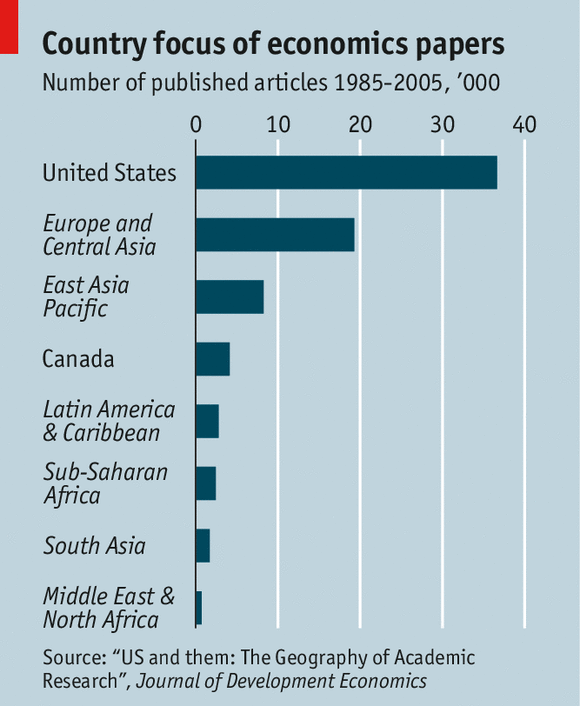
Source: The Economist
The Economist explains this one-sidedness partly by saying that loads of data exists on America so it’s easier to crunch the numbers. Poorer countries aren’t so lucky. But that’s like saying oceanographers should ignore the deep ocean because they haven’t been able to explore it yet. In fact the deep sea is considered one of the last frontiers and scientists are doing all they can to understand it better.
The data obsession of economics highlights one of the main problems of the discipline – its positivism gone loopy. The idea that if something can’t be disproved (and hence measured) then it isn’t science is ludicrous. It would mean that we could say very little about love, friendship or social bonds in general, all of which have important implications for economic behaviour but which are nebulous and difficult to capture in numbers.
Just because poor countries aren’t bulging with reams of data it doesn’t mean they’re invisible. This sort of scientism in effect amounts to the wielding of power. ‘We’ as western academics will develop complex techniques which frame the debate because they only ask certain questions – how big should be the public debt to GDP ratio, does government spending crowd out private investment – and then we’ll analyse these issues to death without considering anything that people in poor countries might care about. Economics thus becomes by definition the study of rich countries.
Lots of research techniques and modes of analysis exist on subjective behaviour, and information can be uncovered if you look for it. Anthropologists have long studied subaltern societies using fieldwork complied over years of immersion in the community.
Much blame for the statistics-mania of economics can be pinned on Paul Samuelson, whose notion of operationalism amounted in effect to the economists’ version of positivism. As Bertrand Russell pointed out, the core principle of logical positivism is self-contradictory because it can’t be disproved.
The Economist cites another explanation for economists’ bias toward the States: that the intellectual kudos in solving a problem about the American economy is much higher than understanding a less developed country. But if economists are so career-obsessed that they’ll ignore the rest of the world then they should be pulled down a rung or two. Countries and people should be much more important than the mathematical games played out in the supposedly top journals.
It’d be interesting to know which journals the study covered, because if you look hard enough there is in fact a fair amount of stuff written about poor countries – it’s just outside the big name journals. As Paul Krugman has recently said, some of the best economics is happening on blogs (no, not this one), in working papers and in online journals like that of the World Economics Association.
The biggest problem with the US-centric nature of economics is that the profession has a universal view of human beings as self-interested, utility-maximising, optimising and broadly rational, when such a view of humanity is only one among many. Economists think that if they hone their techniques in the laboratory of America, then they don’t need to look further afield. But America isn’t a laboratory; it’s a small corner of the world, albeit a powerful one, and one where things work in a peculiar way. Humans don’t behave the same everywhere. In none of the 23 countries I’ve worked in does homo economicus exist.
In the broadly subsistence societies of Melanesia, for instance, many people explicitly repudiate the materialistic aspirations of foreigners, having the self-knowledge to realise that televisions don’t make you happy. It would be laughable to describe the inhabitants of Tanna, one of the southernmost islands of Vanuatu, as consequentialist in the economist’s sense, trading off future expected utilities against one another. There, communities are more important than individual “rights”.
In countries like South Sudan and Lesotho, “the state” can’t be conceptualised as the black box that economists think it can. It’s a varied and complex beast, riven with tribal and special interests – as seen lately. It doesn’t behave remotely in the way that it is imagined that the American state does, as a technocratic institution which is supposed to intervene (or not) according to circumstance. Economies themselves are rooted in social structures, all of which vary because of history and culture.
Even in the United States and Europe, the old notion of strict rationality has come increasingly under question as a result of new research by psychologists.
So for economists to focus only on America is as partial as if biology looked only at floriculture, or as if physicists gazed just at the heavens, and omitted the vast and fascinating research space that exists in the rest of the world. We’d be outraged if any other science was so blinkered. Why not with economics?
The Economist concludes that: “the world’s poorest countries would benefit from having more economists poking around. With more published research, it would be easier for those countries to base policies on hard evidence, rather than on politicians’ whims. Economists ought to be bolder in venturing outside their comfort zone.”
I half-agree, in that economists should hugely rebalance their research. But at the same time without a major overhaul of the techniques and methods of economics I’m not sure I want them to poke around more in poor countries because they might make just as much a mess of things as they have in the rich world.

 Emergent Economics
