World first for Scotland
My piece in today’s Scotsman:

Domestic rubbish reinforces the sea wall on Funafuti Atoll (Getty)
SCOTLAND’S climate justice fund, which aims to alleviate the impact of global warming on developing nations, leads the way, writes Daniel Gay
As you descend in the plane through the clouds, Funafuti looms as a half-crescent in an ocean of improbable blue. Capital of the tiny Pacific nation of Tuvalu, houses are scattered the length of the atoll. Waves wash steadily against the coast, a broken line of coconut palms.
On the ground an all-clear siren sounds, and kids converge for a kick-about on the only place wide enough for a game – the airstrip. In places the island is no wider than the road, which is strewn with shells. The smell of manure floats on the breeze: pigs housed in small shacks by the roadside are a vital source of protein for villagers. The nearest trading partner is Fiji, 700 miles due south.
Tuvalu is at the frontline of the battle against climate change. Rising to a maximum height of 15 feet above sea level, the Maldives is the only country which is lower. Some estimates suggest that the Pacific nation will be swamped within decades as sea levels rise. When I last visited a year ago, the Prime Minister told me that a drought lasting over a month meant that 100 families in the capital had been placed on special water rations. He later declared a state of emergency.
Tuvalu may be the ideal kind of candidate to benefit from Scotland’s climate justice fund, the details of which are to be unveiled in coming weeks, but which aims to alleviate the impact of global warming on developing nations.
The fund – a world first – is part of a growing Scottish commitment to development aid in recent years, starting with the Malawi Development Programme inaugurated by Jack McConnell in 2005 and continued by the SNP Scottish Government. Now totalling £9 million, development funds are being spent on civil society, health, education, trade and sustainable development. Over a third goes to Malawi with the rest divided between Africa and South Asia, as well as being spent on emergency relief work.
At a time of cuts, why is Scotland throwing cash at far-flung places?
Compassion may be a woolly word these days, but there’s an undoubted cross-party commitment to bettering the lot of the worst-off. Scotland’s heritage in this area is second to none. Free-marketeers like to forget that Adam Smith’s other book, The Theory of Moral Sentiments, partly concerned the impact of the “invisible hand” on the less fortunate.
Civil society, that much-abused term, was forged by Adam Ferguson in the furnace of the Scottish enlightenment, a time when many of the core tenets of modern democratic society were born. Humanitarianism has long been central to the Scottish tradition. Treat others as you’d like to be treated yourself, runs the old refrain.
It shouldn’t be forgotten that Scots ran many parts of the British Empire (although not as much of it as is often claimed) and that many now feel a responsibility toward the former colonies from which the nation profited and abused – hence the special links with Livingstone’s former African haunts. In a more modern vein, industrialised countries caused global warming, so they should at least be prepared to cushion its impact on the most vulnerable.
As Devo Max or independence begin to look more likely, Scotland must again make its voice heard in the world. Disbarred from foreign relations and thankfully with no imperial ambitions, aid is a more humane way of getting noticed. A strong international reputation helps Scottish businesses abroad and attracts investment and workers.
What’s unusual about the Scottish effort is that rather than following the somewhat loud-mouthed, one-size-fits-all rituals of Washington, Scots bureaucrats actually appear to be listening to what developing countries want.
Instead of hurling cash at Malawi – the European Union last year did its normal job of asking external consultants what it should spend its €50 million on – the Scottish partnership works on established personal links. The partnership pre-dates government funding, with members including schools, church and academia.
One of the government’s first investments was in Mary’s Meals, a school food charity active in Malawi since 2002. A host of charities have piggy-backed on Holyrood’s efforts, with a recent study by Edinburgh University showing that total voluntary contributions amounted to the equivalent of £30m in a single year.
Responding to the request for environmental know-how, Scots experts have made well-received recommendations on sustainable energy and water. The small-scale, relationship-driven nature of the partnership means that money is better spent.
Smallness has its problems, and some Malawians initially questioned Scotland’s experience, with one local expert doubting whether the initial programme had been properly thought out. A BBC investigation claimed that the money was difficult to trace, and there’s no doubt that the necessarily high fixed administrative costs inevitably formed a high proportion of such a small sum.
Attempts to establish an office on the ground led to difficulties as Malawians queried its neutrality. Civil society work may even be counter-productive, with the perception of European involvement undermining human rights work.
All aid is political, and Alex Salmond is never one to pass up an opportunity to play politics. He will no doubt be pleased that a recent Chatham House study argues that: “The Malawi Development Programme shows that Scotland is capable of handling its international engagement, and may not need the UK to be the final arbiter on matters of development overseas.”
After the 2010 change in Westminster government the British Department for International Development has kept a stony silence on the Malawi programme, failing even to mention the Scotland–Malawi partnership on its website.
This might be because the UK’s £82m donation to Malawi in 2008/09 dwarfed the £4.2m spent by Holyrood during the same period, but some Scottish civil servants are reported to have said that their UK colleagues dismissed their work as amateurish. The unionism of the Conservative-led government probably plays a part.
But Salmond’s politics may yet prove expensive. The UK and Scandinavian governments are among the few countries to commit to an international agreement to spend 0.7 per cent of GDP on development. The problem is, 0.7 per cent of Scottish GDP is about £900m, a hundred times the current budget and patently unaffordable. Either Holyrood continues to play a proportional part in the wider British development programme, diluting its independence, or Salmond modifies his Scandinavian ambitions.
The likes of Tuvalu or Malawi may be a long way from home, but Scotland’s stature is heightened by its development initiatives. Perhaps the last word should be with Adam Smith: “How selfish soever man may be supposed, there are evidently some principles in his nature which interest him in the fortunes of others and render their happiness necessary to him, though he derives nothing from it except the pleasure of seeing it.”
Laos
I’m currently in Laos, where the temperature is approaching 40 degrees Celcius. It’s a bit of a shock after an extended Scottish winter. Tomorrow the government will present the final Diagnostic Trade Integration Study that i’ve been working on over the past few months.
Vientiane seems busier every time I visit. The first time was in 2003, when it felt like little more than a village. The roads were rutted and the traffic was mainly tuk-tuks and noisy old bangers — unlike today, where Landcruisers roam the clogged streets.
There were virtually no banks, let alone cash machines. Now, curiously, they seem to everywhere. I noticed about four within 200m on the road outside the hotel.
It’s probably the one place i’ve been over a period of a few years that’s noticeably boomed. Most of the 7% average annual economic growth over the past decade has been concentrated in the capital, Vientiane, and much of it comes from a boom in hydroelectricity and mining.
Having visited several rural areas last year, the upturn isn’t mirrored throughout the country. As in so many developing nations, some people make it into the middle class and subsequently do all the things that Europeans or Americans take for granted like going to the ATM or fiddling with their iphones. Any backpacker who only sees Vientiane could be forgiven for thinking everything’s dandy.
But almost a third of people languish below the poverty line. Nutrition remains a big problem, with around two-fifths of children underweight and a similar proportion stunted.
During a trek last year we visited a village of Lantan tribespeople near Luang Namtha in the north, emerging from the dark of the Jungle via a system of irrigation channels. We crossed a river on a tilting bridge made of vines then teetered on narrow paths cut between a series of rice paddies before coming to a fence where pot-bellied children with no trousers toddled toward us. A little naked girl held a wicker tray of wrist-bands, following us along a lumpy mud path to a hut which the tour company had built to house visitors.
A smiling lady brought out cokes and more wrist bands, motioning to me to buy one. We sat indoors eating vegetables from banana leaves on the floor while the ladies and children waited patiently outside. We bought three wrist-bands for 50p each.
We could hear coughing from inside the woven huts. Small men with their ribs showing wandered around. A water pump, built with German aid, was inscribed “April 2011”.
Like everywhere, it’s easy to be fooled by the journey from the airport into the capital. First impressions can be deceptive, and aggregates, especially gross domestic product, are sometimes almost meaningless.
The British economy is screwed, but sorting it out would be less controversial than you’d think.
People bleat on about various ‘isms’: Keynes versus Friedman, or whether the solutions lie with market or state. Some say the government could rescue us from crisis single-handed. Others — notably that a whole stratum of middle earth England — seem to have bought the notion that the UK is fatally laden with debt and that anything other than fiscal rectitude of constipatory proportions will lead us the way of Greece and Spain.
I suspect that a lot of the ideological confrontation is false. For a start, a lot of folk don’t appear to understand how government bonds work. Osborne and Cameron induce a collective national flinch by comparing national debt with a household. The narrative is that we should all tighten our belts because Labour over-indulged.
That’s the wrong analogy.
The government isn’t in hock to some crowbar-wielding loan shark. It borrows off you and me. A lot of our bank savings get reinvested in government Treasuries, which are considered super safe even though returns are low.
A better analogy is probably a father lending to his daughter: yes, she probably doesn’t want to take too much advantage, and sooner or later she’ll want to stand on her own two feet, but most dads wouldn’t turn up at their daughter’s door with a large henchman demanding repayment at 1000%.
Here, Jonathan Portes, Director of the National Institute of Social and Economic Research, points out that some of the most moderate voices suggest that Britain should spend its way out of the bust. Even conservative chancellor Norman Lamont (for whom Portes wrote speeches) purposefully held off raising taxes and lowering spending during the last recession in the early nineties.
The IMF, normally a bastion of budgetary conservatism, says that the British government could boost the economy by balancing spending with tax hikes.
the Fund wants us … to spend more on infrastructure (and housing) and increase welfare benefits for poor people (who will spend them), and pay with it by taxing the rich (those with a lower “marginal propensity to consume”). This would raise demand in the short term, without worsening the fiscal position.
Number 11 Downing Street can borrow almost for free to pay for the infrastructure precisely because the economy is floundering and there aren’t that many other places to invest. By buying government debt foreigners, too, are giving a vote of confidence in British standards.
But the current coalition has so committed itself to austerity that it can’t backtrack.
Of course, the Conservatives have ideological fixation with the free market. Some of their posh mates will stand to make millions out of the privatisation and contracting out that comes with shrinking the state. I’m not saying that ideology is dead. Debt is also high and needs to be paid down.
But Cameron and Osborne appear handcuffed in some Bullingdonian death pact in which they have to follow through their austerity until the rancid conclusion. It’s as if they’ve squeezed inside a sports bag, somehow padlocking it from the inside, and now they can’t get out.
The revolution isn’t nigh
I love it when financiers get philosophical. The academic slaverings; the sense of certainty; the reference to political ideology.
The latest effluvia from Hugh Hendry, ‘contrarian’ Scottish fund manager, has it all:
Why does France in 2012 flirt with the notion of electing a socialist president intent on reducing the retirement age, imposing a top rate of tax of 75% and increasing the size of the public sector? Why do we hang on the every word of elected politicians when Luxembourg’s prime minister Jean Claude Junker openly admits, “When it becomes serious, you have to lie”?
You cannot make stuff like this up. It is simply too absurd.
That is perhaps a long way of saying that existentialism is alive and well in the 21st century. For, if the last ten years have taught me anything, it must be that the French philosopher Albert Camus, in his search for an understanding of the principals of ethics that can shape and form our behaviour, may have surreptitiously provided us with three basic principles for macro investing. I am perhaps doing him a gross injustice, but I would summarise as follows: God is dead, life is absurd and there are no rules. In other words, you are on your own and you must take ownership of your own destiny.
No, no injustice at all. I’m pretty sure I remember that on page 34 of The Outsider, shortly after Meursault discusses the stock market over dinner with Ayn Rand.
Like the best in the business, Hendry can’t wait to talk about himself.
[W]hat makes a great fund manager first and foremost is the ability to establish a contentious premise outside the existing belief system and have it go on to become adopted by the broader financial community. Bruce Kovner [whoever he is] expressed the idea more eloquently when he said, “I have the ability to imagine configurations of the world different from today and really believe it can happen. I can imagine…
Wait for it.
…that the dollar can fall to 100 yen”. I am sure you are nodding in agreement, except Bruce was saying this when the USDJPY was well over 200, not today’s rate of 80.
When it was above 200? Man the barricades! This is the currency-trading equivalent of Lenin arriving in St Petersburg to deliver the April theses. Contrarianism like this has the potential to rock the globe. I’ve long thought that we needed a new Keynes, but maybe he’s among us already, someone who can even conceive of a configuration of the world in which the Japanese exchange rate drops a bit.
Hold on to something stable, for it gets even more unnerving. Hendry himself has “the kind of imagination that can imagine the yen trading closer to 60”. Gosh, that kind of imagination, one that can even guess that the economies of Europe and the United States might grow differently to Asian ones.
You cannot make stuff like this up. It is simply too absurd.
How not to run an economy
Another nasty graph, at least if you’re British. Ethan Pollack of the Economic Policy Institute shows that Britain’s economy quickly stalled after the election of the Condem coalition in the summer of 2010. A year and a half later the economy had shrunk and more people were out of work. The United States didn’t cut government spending so heavily, allowing its economy to keep growing.

The UK tax hikes and spending cuts were to be worth an extra 2.2% of GDP, or £40 billion, by 2014-15. On top of the cuts already promised by the previous chancellor Alistair Darling, the total austerity package amounted to 6.3% of GDP. George Osborne made another particularly silly mistake, promising that he’d keep many of Labour’s tax rises and even implement more in the form of a VAT hike, which further strangled growth.
It doesn’t take a genius to work out that if the British economy is worth about £1.5 trillion a year and you rip roughly £94.5 billion out of it over three years something’s likely to go banana-shaped. By shrinking the economy Osborne shot himself in his patent leather, calf-skin brogue. When businesses earn less or go bust and people don’t work, they pay less tax and you need to hand benefits to the jobless. So the government has to borrow more and tackling the deficit becomes harder.
Osborne and co. try to blame the Europeans, but everybody knew the world economy was faltering, and anyway British exports haven’t collapsed.
The financial press made a big noise on Wednesday about news of the so-called technical recession, but Britain’s economy was already depressed and it’ll keep floundering for a long time to come.
Another telling graph. Since the crisis Britain’s economy has shrunk more than any G7 economy except Italy’s. (from Gavyn Davies in the Financial Times).
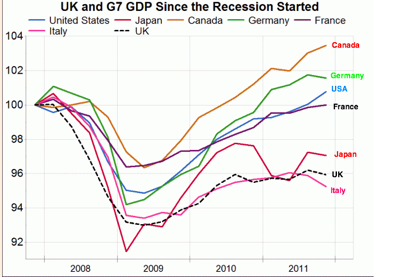
We’re all in it… together
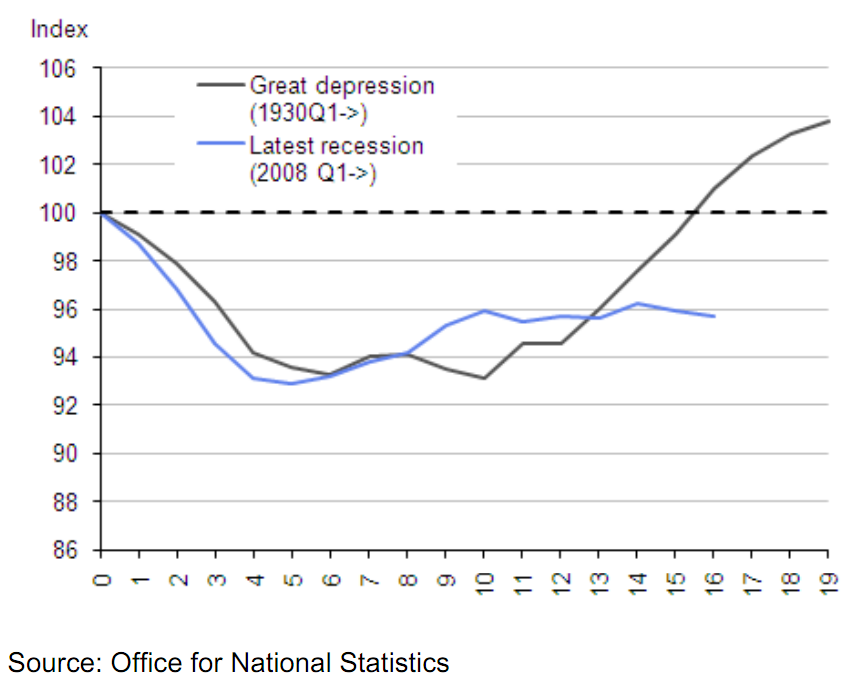
Never mind all the fuss about whether Britain’s economy is in technical recession. The much more important point is that the economy is still much smaller than at the start of the crisis four years ago. The contraction is worse than the great depression. From Michael Roberts:
Poor economics
The latest trend to arouse development economists is the randomised controlled trial. Borrowed from biology and healthcare, it’s when a researcher picks two or more different groups according to the roll of a dice, giving each group a different drug or treatment. The scientist can be fairly sure that the best-responding group has been given the intervention that works.
In development economics the researcher tests policies or techniques instead of drugs. One group, randomly chosen, receives the policy to be tested and one doesn’t, with an attempt made to keep all other circumstances equal. This avoids the problem of selection bias: the economist might distort the results by choosing a group which is particularly willing to take part or where she knows a technique will work well. It’s why the results of those pop surveys after you’ve visited a website aren’t to be trusted. The answers only come from the type of person who can be bothered to fill them in.
In a 2007 paper Benjamin Oken tried to measure ways of reducing corruption in Indonesia. He chose 608 villages in Indonesia where roads were to be built, splitting them into groups: ones without audit vs. those with audit; those featuring invitations to accountability meetings vs. those without; and ones with invitations to accountability meetings along with anonymous comment forms. Oken found that less money went missing in the villages with government audits than in the ones featuring grassroots participation in monitoring. The conclusion: audits cut corruption better than the other methods.
Oken works at MIT’s poverty action lab, of which Esther Duflo and Abhijit Banerjee are directors. They’re the authors of a recent bestseller, Poor Economics, which uses experimental evidence to discover what methods best lower poverty. Over years they did more than 240 experiments in 40 countries.
Some of their conclusions run against received wisdom. Political corruption isn’t too bad. Microfinance (tiny loans for poor people) is no magic bullet.
Fans of randomised trials are right that there’s no big answer. Lots of development fads boil down to the researcher’s arbitrary preferences rather than to hard evidence. Development sometimes seems like a Roman arena in which big, shouty men try out different ways of stabbing each other. The actual subjects — poor people — are often forgotten.
Experimentalists are also right to deny that everything’s down to corruption. That’s often just a sloppy byword for blaming the poor for their own problems. If you didn’t tolerate kleptocrats, the argument goes, you’d be richer. But lots of corrupt countries aren’t democracies, and plenty of corrupt countries got rich (China springs to mind). Some reasonably graft-free nations continue to toil.
But i’m a bit wary of these sort of experimental approaches, which amount to tinkering rather than really changing underlying conditions. There’s no understanding of capitalism as a system and very little about the exploitation of labour by the wealthy. You don’t need to be a raving socialist to understand that what’s good for the poor often isn’t good for the rich. We get cheap Iphones because Foxconn holds wages so low.
As this review says, there’s little real understanding of power in development. It’s as if the world is gradually tiptoeing toward a better understanding of poverty, and by carefully applying a few well-founded scientific results we’ll eventually live as one happy tribe. Call me a cynic, but I think power relations play a bigger role than most people admit. It’s actually beneficial to have a multi-million strong pool of underpaid or unemployed people clamouring for jobs because it keeps wages down and lets us have cheap stuff.
Experiments may work in medicine, but they can be methodologically dubious in social science. The gist of philosopher Nancy Cartwright’s presentation at INET is that the sample size needed for a fully objective study can be so enormous as to be impossible. Researchers often draw completely unwarranted conclusions from these studies.As pointed out by Marx and others, ’empirical facts’ are often distorted by their proponents. One person’s common sense is another’s ideology. I’d imagine that the sorts of questions asked by most middle-class academic Americans aren’t always the same as the sorts of things that many poor people themselves would ask.
Most of these trials also seem to fail to take enough account of context. What works in one culture might not be generalisable elsewhere. Cash incentives don’t work as well in the communitarian cultures of the South Pacific as they do in, say, Kenya. When people have plenty of food and are generally happy, they’re less likely to work hard for more pay.
Because humans are at the same time the architects of their own theories and its subjects, the problem of reflexivity emerges. The results of experiments may be valid in one situation for a short period of time but they can’t really be taken as hard fact for eternity in the same way as findings in natural science can. So most findings are only provisional and context-dependent. Such is the eternal dismalness of social science. This isn’t a body-blow to experimentalism in economics, but it does reduce its importance.
–David Hume, An Enquiry Concerning Human Understanding
Not-so-super models
Jonathan Schlefer’s The Assumptions Economists Make looks interesting:
This book is about what economists do in their secret lives as economists, when they aren’t dashing off op-eds to tell everybody else what to believe, pulling the wool over undergraduates’ eyes in textbooks, or otherwise engaging in public relations.
Schlefer trained in politics not economics. As Aditya Chakrabortty said in Monday’s Guardian, at a time when the dismal discipline has so failed us, non-economists should be stepping in. Schlefer says all the right things, like “political science is not a science like physics.” He slags off neoclassical economics, talking of “the realism of crucial assumptions: assumptions that crucially affect the picture of the economy you are trying to understand.”
I haven’t read the book but I agree with David Ruccio, whose work I admire and who highlights the following passage from the interview. Schlefer says that:
There is a kind of progress in economics. Critics point out flaws in models; supporters revise the models to respond; and the models do become sharper. For example, John Maynard Keynes’s “General Theory” was a brilliant book, but his model was somewhat muddy, if you even grant that he had a model per se. If his model had been clearer, there wouldn’t have arisen so many disputing schools of “Keynesians” (with various prefixes and suffixes to distinguish themselves). But whichever side you’re on in these disputes, the models favored by different sides have become sharper and the bases of disputes clearer.
Keynes was perfectly well aware of the problems with narrowing down his approach in terms of a model, and there’s a copious literature on the purposeful openness of his economics. Ruccio rightly draws attention to:
the modernist conceit in economics: that economic knowledge progresses (Samuelson would add, “funeral by funeral,”) and that modelling is the way to guarantee the continued “march of progress.”
Models aren’t the only way of doing economics, and I have strong doubts that economists are gradually improving their understanding of how the economy works. The global economic crisis certainly doesn’t suggest so, and neither do the wars between various camps: freshwater versus saltwater; neoclassical versus post-Keynesian. The boundaries are muddier, not sharper.
Well-grounded methodological reasons exist for believing that narrow, highly mechanistic models with unrealistic critical assumptions are inappropriate for the social world. I think economics should be much more empiricist and narrative-driven, rooted firmly in the precise circumstances of the country or situation being examined, with theory subject to periodic revision as new evidence arises. There’s also lots to be learnt from disciplines like sociology, anthropology and politics, which have less robot-like ways of doing things.

 Emergent Economics