Rodrik on economics
Dani Rodrik is one of my favourite mainstream economists. The book One Economics: Many Recipes is actually useful for practical development economics, unlike most of the standard stuff. Rodrik’s methodological one-dimensionality, revealed in the title of his book, is less useful. Economics features many flavours, including at least Keynesian, institutionalist, Marxist, feminist, Austrian, Ricardian and neoclassical. So Rodrik is factually mistaken.
He’s also unhelpful. Pluralism would be a much more healthy state for the economics profession, reflecting the range of actually existing schools of thought and shedding light on hitherto unexplained economic problems. No other social science is so one-dimensional. It is arrogance to suppose that one particular method can explain most things. Lots of other disciplines are pluralist because they reflect our inability to know for sure whether we’re right. A bit like parliamentary democracy, which features several competing perspectives, the non-economic social sciences generally allow various views rather than stamping out or ignoring the opposition.
Statements like the following, in this interview by Rodrik, are worrying:
…what we teach our students in the classroom – the advanced students if not the undergraduates –and what we talk about in the seminar room are typically much more about the myriad ways in which markets fail.
What? It’s OK not to teach undergraduates that markets fail? I continue to find it ridiculous that you can go through an entire undergraduate degree starting from the standard assumptions of perfect competition, foresight, a lack of externalities and rationality. When I did undergraduate economics I found these assumptions bizarre, and doubtless so do many current students. Markets clearly do fail, and catastrophically did so during the 2007/8 crisis. Many people think that markets fail all the time.
Why start from a perspective that suggests that everything is smooth and finely-balanced and relax those assumptions later, when nothing about the economy is smooth and finely-balanced? Perfect competition almost never happens. People aren’t generally rational, nor do they possess anything approaching 100% foresight. Equilibrium is an ageing physics metaphor that can’t describe how markets really work. Why not start from a vaguely realistic perspective? Surely a method which was somewhat nearer the actually existing conditions of human society would have a better chance of explaining it and predicting the future. Starting from the ludicrous idea that markets never fail is a bit like trying to reach New York by starting in Mongolia. It’d be quicker to start in Washington D.C.
The well-known cock-ups of economics — Black-Scholes, the efficient markets hypothesis, Modigliani-Miller and more — result largely from the blinkered attitude of the mainstream. Economists felt certain that the core methodological foundations of the discipline were well-founded, and none of the tiny minority of dissenters were listened to. Some highly contentious theories weren’t exposed to the fresh air of radical critique.
Rodrik is more interesting when he says that:
…contemporary economics in North America has one great weakness, and that is the excessive focus on methods at the expense of breadth in terms of social and historical perspective. PhD programs now train applied mathematicians and statisticians rather than real economists. To become a true economist, you need to do all sorts of reading – from history, sociology, and political science among other disciplines – that you are never required to do as a graduate student. The best economists today find a way of filling this gap in their education. I consider myself very lucky that I was a political science major and did a master’s in public affairs (as it is called at Princeton) before I turned to economics. I say lucky, because some of my best work – by my judgement, at least – was stimulated by questions or arguments I encountered outside of neoclassical economics.
…
There are powerful forces having to do with the sociology of the profession and the socialization process that tend to push economists to think alike. Most economists start graduate school not having spent much time thinking about social problems or having studied much else besides math and economics. The incentive and hierarchy systems tend to reward those with the technical skills rather than interesting questions or research agendas.
Rodrik’s right that too much of modern economics is just applied maths and statistics. But he surely understands that contemporary economics by definition excludes politics, history and sociology? Neoclassical economics is itself purposefully one-dimensional, thinking that it can achieve everything ahistorically and with no reference to society as a multifaceted and power-based institution which is always political. It’s no good for him to say that he was “lucky”. Every student should be lucky enough, like Rodrik, to study realistic political economy. In this sense the statement above contradicts itself. Rodrik implicitly understands that the economics profession needs to be radically overhauled — methodologically — so that it stimulates students to answer questions or arguments outside of neoclassical economics.
This is in no way to suggest that my own sort of economics — which features bits of Keynes, Marx, Kalecki and Hirschman and Sen — is correct; only that we should listen to a whole range of perspectives so as to be sure we get things right, and that we should argue about them rather than pretending there is only “One Economics”.
This speech, by Irish President Michael D. Higgins caught my eye because I increasingly think of neoclassical economics as narrow decision theory: appropriate in some circumstances, chiefly for the last 10-20 years in the fields of money-making and finance, but completely useless in others, such as in development and macroeconomics.
We cannot, however, ignore the fact that European citizens are suffering the consequences of actions and opinions of bodies such as rating agencies, which, unlike Parliaments, are unaccountable. Many of our citizens regard the response to the crisis as disparate, sometimes delayed, not equal to the urgency of the task and showing insufficient solidarity.
They feel that the economic narrative of recent years has been driven by dry technical concerns; for example, by calculations geared primarily by a consideration of the impact on speculative markets, rather than by sufficient compassion and empathy with the predicament of European citizens who are members of a union.
In facing up to the challenges Europe currently faces, particularly in relation to unemployment, we cannot afford to place our singular trust in a version of a logistical, economic theory whose assumptions are questionable and indifferent to social consequences in terms of their outcome. Instead of a discourse that might define Europe as simply an economic space of contestation between the strong and the weak, our citizens yearn for the language of solidarity, of cohesion, for a generous inclusive rhetoric that is appropriate to an evolving political union.
Mainstream economics works in certain circumstances and at certain times for certain purposes. It’s not really economics, which is about providing for each other. Most critics get it wrong; they talk about ‘the failure of economics’ when it doesn’t fail for the purposes for which it was intended, which are mostly to make a lot of rich financiers even richer.
A profitable route for economists who don’t like the mainstream would be to develop a set of theories or a project that marginalises what now passes for economics in its narrow sense, and departs from it, building a new set of beliefs and techniques which help us provide for each other. Economics needs to be closely linked to practice, meaning the actual on-the-ground conditions in which most ordinary people live, which are not conditions of western luxury.
The two billion or so people who live on less than $2 a day do not benefit from economics as it is currently practiced. It’s not for them. Neither are the complicated mathematical contortions that pass for empiricism relevant for how most people live. These endless regressions reduce people to mere aggregates, components of an imaginary system, when in reality people are independent, critical and sentient, and capable of unpredictable behaviour.
The problem with critiques hitherto is that nobody accepts them because bits of economics clearly do ‘work’, for a time, for certain groups, in their narrow field — like Black Scholes, Modigliani Miller and the efficient markets hypothesis. But these theories don’t always work and they are useless for the wider task of political economy. They don’t help us provide for each other.
An FAQ for Mainstream/Neoclassical Economists
I was just rereading the post on Unlearning Economics about what’s wrong with economics, and remembered just how good a post it is. I wish more commentators were as uncompromising and direct in their criticism. A particularly good section quotes Noah Smith:
However, as for the complex models, Noah Smith explained it best:
The whole notion of thinking of each interesting feature of the economy as a “friction,” and then of considering only one or two “frictions” at a time, has been very detrimental. For one thing, it makes it hard to develop a useful model of the economy, since the actual economy contains many, many “frictions” (so many that the “frictions” together are usually more important than the “frictionless” dynamics that supposedly “underlie” them). Also, the “one friction at a time” approach makes it very difficult to generate any alternatives to the classical “core theory” of Walrasian general equilibrium.
Argentina’s Andean inflation rate
Visit almost any restaurant in Argentina and the menu will be printed on paper and slotted into a plastic binder; not because the owners are cheapskates but because prices must constantly be updated. It’s the original example of what economists call the menu costs of inflation.
The official rate is 10.8% but private estimates suggest it’s two-and-a-half times higher, meaning that prices rise each month by roughly the same amount as in Britain every year. Argentina earlier this month became the first country to get an official slap on the wrist from the International Monetary Fund for fudging its numbers.
Today we made our regular ATM withdrawal and noticed that the fee had risen to 20 pesos from 19.72 in January: even the banks have to cover their costs. We take so much cash out because not many shops take credit cards. By the time Amex, Visa or Mastercard has paid them back the money is worth less. The peso is depreciating about as fast as prices rise, so that every time we visit the cash machine we get a little bit more to the pound.
Another price oddity: we had to buy about 20 stamps to send a parcel home because even the largest denomination is now worth so little.
All these little signs accompany a lot of justified grumbling about the cost of living. Argentina currently tops the Economist’s Big Mac index, which gives a rough idea of the inflation-adjusted price of goods worldwide. Food costs have spiralled so high that they pose a serious threat to the poor.
Per capita income is only a third of Britain’s and poverty remains stubbornly entrenched. The government says income poverty fell to to 6.5% of the population last year although private estimates put the numbers higher. The outskirts of Mendoza, the most recent town we visited, are a troubling mix of corrugated shacks alongside high-walled houses built with wine money. Here, like in Buenos Aires and other big towns it’s common to see children begging. We saw families rummaging through rubbish tips. The Gini coefficient, a standard measure of inequality running from zero to 100, is 44.5 (the higher the more unequal), the same as the Democratic of the Congo and well above the European Union’s 30.
But although income poverty is a problem it has tumbled since the peak of the crisis in 2002, when half of the population was considered poor. Wages are increasing roughly in line with inflation, keeping the cost of goods within reach of most people with jobs. Unemployment was only 6.9% in 2012, lower than in Britain and Europe. President Christina Kirchner in early February unveiled measures to help people on fixed monthly incomes, such as pensioners. The government also struck an agreement with supermarkets to fix prices for two months.
In contrast to London, Buenos Aires is pursuing a strategy of growth — and sometimes inflation can be a price worth paying. Lots of economies, such as South Korea, developed fast for decades with high inflation. The government knows that the only way to tackle poverty is to keep control of public debt and grow the economy. The public debt to GDP ratio is less than half that of the UK and economic growth higher. The Argentinian economy is slowing (which probably means that inflation will fall from its currently unacceptable levels) but last year the economy still grew faster than the rest of the world, continuing its decade-long surge after the crisis. Growth will in turn generate the tax revenues necessary to pay off debt and maintain social spending.
Inflation works to the government’s advantage by eroding the value of debt. Borrow 10 pesos now, and when it’s paid back a year later it’ll only be worth about three-quarters in today’s money (it helps private debtors in the same way). Buenos Aires also benefits from understating its price data because a large part of its sovereign borrowing is indexed to inflation. Some say that’s cheating, but as a cash-strapped government with a history of debt problems and political instability, shouldn’t it be doing everything it can to stay in the black?
All of this is anathema to the International Monetary Fund, which still sings a standard refrain: keep a lid on prices. Don’t print too much money. Don’t overspend on the poor, unemployed or elderly. It’s a refrain that sounds increasingly dated as Argentina prospers regardless. Meanwhile the UK, with its supercharged austerity, suffers its worst slump since the Great Depression.
Cuban revolutions
The blog has been so silent recently because my wife and I have recently been cycling across Cuba. Raul hasn’t quite yet transformed the island into a broadband paradise, so blogging proved impossible. I’m going to write more at some point, but overall the trip was a revelation. For me Cuba has always been a political abstraction – an unlikely aberration in a warming world (in more ways than one) rather than a real place with people in it. I’d read Che and some of his biographies; i’d flicked through the articles on the Bay of Pigs and the missile crisis; I knew all about America’s trade discrimination and the exploding cigars. I imagined it’d be a bit like an enlightened version of other supposedly Communist states like Laos or Vietnam. I bought the standard line that you “have to visit soon before the regime collapses”.
The regime isn’t going to collapse soon. Power isn’t vested entirely in the current Castro just as Fidel didn’t rule with an iron fist. There’s a complex democratic structure including an elected national assembly, a council of ministers and a council of state. A successor to the President will be found, and likely not a revolutionary capitalist. Reuters describes Vice President Jose Ramon Machado Ventura as a “hardline communist ideologue and old guard revolutionary,” whatever that means. People can vote out their national assembly member if they want, very much unlike in the former Communist countries with which Cuba is often unfairly compared. Foreign analysts (mostly US-based, and trotting out the standard tropes about human rights and democracy) have so often been proved wrong about the collapse of the system because they are blinded by a desire to see the Castros crumble and because their liberal ideology fixates on personalities. They can’t see the wider political and social structures that underpin the regime.
Local politics is probably more responsive than it is in the US or UK. The opportunities for Cubans to influence politicians are ample. In seven weeks we met not a single person who wholeheartedly opposed the Castros, even though many grumbled. Even Granma, the dull and staid national paper, features critical letters. Maybe the lack of obvious outright opposition is because people were frightened of talking to tourists, but I doubt it. Almost everyone was grateful for the free, excellent and universal healthcare and eduction. There is a doctor per roughly 117 people and the achievements in schooling since the revolution are astonishing.
Another thing which struck me was the degree of racial and sexual equality. There appeared to be almost no discrimination against coloured people. Women were to be found in most professions. The orchestra playing a concerto by Rodriguez in Santa Clara, the town where Che is buried, featured two female conductors and was almost exactly split 50:50 between blacks and whites, roughly mirroring the racial composition of the country. How many coloured people do you see in a British orchestra? How many women conductors?
The support for the system was marked: a lady called Terisita who we stayed with in the same town said she’d spent 10 years in Florida but came back in 2010 because she “didn’t like the United States”. Life was too hard, medical treatment over-priced, and the pensions too low. At the age of 80 her dad still had to work as a porter in an expensive condo.
A 21-year-old we met in Trinidad who’d grown up in Canada said he loved his country but wanted to be allowed to travel more, criticising the cost of Internet access and the lack of foreign TV (the X-Factor isn’t all that great, I wanted to tell him). He was no anti-Castroist; just a reasonable critic.
The former TV journalist we stayed with in Havana was equally mild in her objections, saying that the government’s big mistake was to neglect infrastructure and the maintenance of buildings in Havana. I agreed. It was troubling to see the old city crumble, and despite the empty roads being ideal for biking it couldn’t have been much fun for locals to rely on sporadic bus transport or hitching. She said her reporting used to go uncensored although she never directly criticised the president.
Cuba’s main problem is probably not internal instability but low wages. The tourism boom is in effect a confrontation with capitalist prices. Doctors earn about $25 a month, which is ridiculous given that Casa Particulares (a bit like bed and breakfasts) charge the same per night. We met several medical professionals moonlighting as taxi drivers in their time off. Ordinary low-skilled employees of state companies earn about $10 a month. That’s fine when the cost of living is so low (I particularly enjoyed the 20-cent pizzas), you receive daily rations of bread and other staples and when electricity and water are provided virtually free. When the country was shielded from outside contact the domestic pay structure probably worked, but with the influx of tourist dollars the system malfunctions.
I’m not one of those naive materialists (like most Marxists and neoclassical economists) who believes that people are motivated only by money. When your country is emerging from a brutal dictatorship and when real change is being built, you probably will work for a shared ideal. The lingering willingness to work for the common good was remarkable. But when the social contract breaks down it seems less likely that people will put up with poor pay.
But why are salaries so pitiful, and why has Cuba had to rely on tourism so much? In large part it’s because of US trade sanctions (Venezuelan oil is another economic lifeline). In a particularly rash outbreak of US hypocrisy, the Helms-Burton legislation passed under Clinton in 1996 not only bans all American tourism and trade with Cuba but discriminates against foreign companies which invest in or export to the country. This staggering violation of international trade law (OK, Cuba isn’t in the WTO but the US gets militant about much lesser matters) is a bit like Britain being prevented from trading with mainland Europe. The UK would no longer to be able to access the £18 billion worth of goods it imports from Europe each month or to export products worth £12 billion. Tourism and investment would be a fraction of what they are now.
Given Cuba’s lack of access to normal international markets it has little choice but to rely on foreign visitors for its hard currency.
So when people talk of the Cuban system ‘failing’ or of its forthcoming downfall, i’d say the point is not so much the inadequacies of the current set-up but its amazing resilience in such a hostile environment. Discussing Cuba’s undoubted flaws is perhaps to get things the wrong way round. The country shows what’s possible rather than what isn’t. Maybe i’m like one of those misty-eyed 1960s leftists who flew out of Havana full of hope for humanity. But in a cynical world, full of nit-picking and pessimism, maybe a bit of hope is no bad thing. Cuba at least shows that things can be done differently.
Thoughts on Haiti
I was working in Port-au-Prince last week during hurricane Sandy. The rain was so heavy that it drove many people on to the streets where they stood at the roadside, drenched. I was struck by how quickly debris washed off the hills and lay across the road, like in some apocalyptic disaster movie. By Thursday the normally gridlocked traffic had all but disappeared.
The government said that dozens of people died and that widespread flooding destroyed roads. Mudslides swept buildings away, sending more than 5,000 people into the already overcrowded temporary camps scattered across Port-au-Prince, home to families who lost their houses in the 2010 earthquake.
I can’t imagine how awful it must be to cower in a makeshift tent during a week-long deluge, so soon after having your home wrecked by another natural disaster. Even before 2010 the country was already grindingly poor. Over half of all people live beneath the international poverty line of $1.25 a day adjusted for the cost of living. That’s about 5 million people subsisting on 78p a day.
Last week I visited MINUSTAH, the Brazilian-led UN mission. It’s a blue-and-white city near the airport where staff go to work in air-conditioned portacabins. I’ve never seen so many white Toyota Landcruisers. I even glimpsed an armoured personnel carrier. The base is so big, apparently, that the trade statistics show a significant increase in imports from Latin America.
In Petionville, the posh end of town, razor-wired mansions tower over slums. We went for a jog between 100-foot high walls with medieval iron gates. Rows of low concrete houses cover the steep hillside, just visible through the palms that fringe the gated community in which we have the misfortune to be imprisoned. At night a few lights go on but electricity is too expensive for more than a bulb per house. They’re the lucky homes. Apparently the quake hit hardest in the low-lying areas near the coast. I’ve been banned by work from going there because it’s supposed to be too dangerous. The murder rate in the city this year jumped to 60 per 100,000, about 10 times the global average. Guns are everywhere.

If numbers can even vaguely capture such iniquity, the Gini coefficient is 59.2 (the closer to 100, the worse. Most countries have a level of 20-30). Only five countries are more unequal: Botswana, Namibia, South Africa, Comoros and the Seychelles. Despite foreign aid of US$4-5 billion since the earthquake in January 2010, Haiti’s unemployment rate is still an unbelievable 90%. No, I haven’t got that the wrong way round. Only about one in ten people have proper jobs. For those lucky enough to have regular work the minimum wage is $5 a day. The others sell things by the roadside or make a few dollars where they can.
The economy basically revolves around aid, money sent back from Haitians living abroad and making American t-shirts: about three-quarters of exports are garment sales to the United States. Local farmers have been put out of business in recent years by an influx of cheap rice and environmental degradation. An enormous proportion of the country’s forests have been felled. Mudslides make farming impossible in many areas.
Almost all consumer products are imported. The country has run a trade deficit for many years, mostly due to an ultra-liberal trading environment under which average tariffs are half the level of regional neighbours and where the economy is almost entirely open to foreign investment — a result, largely, of pressure from a certain neighbour to the north.
All in all, not a pretty picture.
On the bright side, most of the senior officials we’ve met are highly articulate, well-educated and hopeful. The main trade-related government departments have staff who could turn Haiti around if they were allowed to.
As in so many poor countries the problem is not bad decision-making or an absence of talent. Haiti’s chronic underdevelopment is due to terrible leadership and a difficult international situation. Haiti is much poorer now than under the Duvaliers in the 1950s-80s. They were the worst kind of dictators; people who ran the country as their personal fiefdom in a brutal, cynical and stupid process of self-enrichment. Stupid in the sense that unlike some autocrats the Duvaliers didn’t understand that if they grew the economy there’d be more to steal. They appear to have just ripped off what they could — Papa Doc used the national tobacco company as his personal slush fund — without bothering to move the national economy forward.
They didn’t act in a vacuum. The United States has long interfered in Haiti. Reagan supported these despots in the early 1980s because of their anti-communism, before eventually persuading them to leave for France in 1986. In 2002 the US is rumoured to have helped depose the first democratically-elected president, Aristide, flying him against his will to the Central African Republic.
Haiti has the strategic misfortune to lie near the entrance to the Panama canal, through which half of the world’s ships pass. It’s also been an ally of Cuba, only sixty miles to the northwest. The US has such influence in economic policy that over past decades it was able to prise open Haiti’s markets and liberalise trade. Now, a host of foreign businesses hope to buy up tracts of land for golf courses and self-contained resorts. The current president is perhaps more bearable than the Duvaliers but he’s still America’s man.
Despite all the development money and the massive UN force and the well-intentioned officials, development will always be a matter of politics. Things don’t look like improving quickly for the poor of Port-au-Prince. Americans, like most of us, love their cheap t-shirts too much.
I got a badge
I don’t win many badges but my website this week won an award as one of 100 enlightened economics sites.

I will, virtually, wear the badge with pride.
Laos’s economy: growing fast, unequally
The trade diagnostic study which I led in Laos has just been published. Laos, normally seen as a chilled-out Communist backwater, has one of fastest-growing economies in East Asia. The country will probably leap into middle-income status within the decade. But inequality is rising and poverty remains stubbornly entrenched.
Mining and electric power accounted for just over half of total exports in 2008 but the proportion is expected to reach three-quarters in 2020 as huge new dams and mines continue to crank up output. Half of exports, largely electricity, go to Thailand, which is also the source of three-quarters of imports. The economy risks becoming over-dependent on its neighbour.
Although big social gains have been made, many people haven’t benefited from the resource boom. Natural resource development has in some instances actively worsened poverty through resettlement and reduced food security. Including downstream communities, up to half a million people (in a population of 6 million) may have been displaced or affected as the dams change the flow of the river and the quality of water, damaging fisheries, paddies and vegetable gardens.
A quarter of people live below the poverty line. Nutrition remains a significant problem, with around two in five children underweight and a similar proportion stunted. Since the start of the economy boom in around 2002 inequality has risen to levels almost as bad as those seen in Vietnam and Indonesia. Lao PDR fares badly on the UN Human Development Index, at 138th of the 187 countries on the latest Index.
Given the impact of resource-led development on the natural environment and the concentration of economic activity and exports, the report recommends moving away from gross domestic product, which doesn’t account for equity or the environment, towards an alternative measure of development such as China’s GDP quality index; Gross National Happiness or the UN Human Development approach. Among the main tasks facing policymakers in the years ahead are the redistribution of earnings from natural resource projects; the diversification of economic activity into new areas in addition to hydropower and mining; and the establishment of appropriate human development policies — particularly education and health — as the foundations of long-term economic success.
Government officials were surprisingly receptive to the idea of moving beyond GDP. The breakneck speed of economic expansion and its associated inequality indeed suggest that a new approach needs to be adopted if Laos isn’t to become another example of growth without development.
The report is here.
Placing the poor in Singapore
The latest whistle-stop Singapore bullshit from the Torygraph can be summed up in five words: chewing gum, cleanliness and authoritarianism. The journalist might as well have saved himself the other 1,506.
“Whoever heard of Asia without car horns and dementedly weaving traffic?” he asks. But a Facebook friend who posted the article quite rightly suggests that the reality is a lot more nuanced. Why do Asian countries always have to be dirty and anarchic? Does Singapore’s order and cleanliness make it less authentic than, say, Phnom Penh?
I don’t know. There’s something weird about the place that seems to slip through the fingers. Singapore is like one of those blue screens they use for special effects in action movies, or maybe those magic eye pictures that were cool in the 1990s. A foreigner like me sees gum and the Rotan cane. Supporters of the government: infallible technocrats on an glorious march to prosperity. Most ordinary locals: not Indonesia and not amok.
Like anywhere the place can be understood on lots of different levels, and those levels rarely seem to come across in the international (or the national) media. When I lived there I often used to wonder in particular what the builders of Singapore thought; the Indians and Bangladeshis on short-term visas who lived in container towns sprawled anonymously near the airport. The Torygraph journalist notices that they “flood in from their workers’ dormitories in the west of the island to let off steam. Most head for Little India because they’re mostly from the Indian subcontinent.” But he doesn’t think to interview any.
I was never sure the voices of the majority of the population who live in government Housing Development Board estates were really heard, either. The national narrative was all discipline and dollars; shiny office blocks and hedonism.
Poor people are silenced in lots of places, but the degree to which they are muffled varies enormously. At least in Bangkok, Johannesburg, Buenos Aires and Paris gatherings of more than four people are legal. Even in Hong Kong, protesters last week managed to overturn the requirement for mandatory Chinese propaganda on the school curriculum. Often the most precious social gains in the wealthy world have been driven from below.
Singapore is somewhat unique, and I think, fascinating, for being so rich — the third wealthiest in the world per capita — and yet having a medieval justice system and a democracy with so many vital organs missing. When countries get rich they often develop things like an independent press, trial by jury and a minimum wage. Yet none of these exist in the lion city, whose ruling People’s Action Party hounded the handful of opposition politicians out of office, bankrupting one and jailing another.
It’s a country founded on supposedly egalitarian principles, where in the early days leaders would harp on the need for everyone to have a decent flat and go to school. First finance minister Goh Keng Swee’s book Socialism That Works: The Singapore Way was a great example of post-colonial nose-thumbing at the laissez-faire ways of former masters. Most of the lefty stuff’s long since been ditched, but the government has always said that it’ll stick its nose into people’s lives for the good of the country. The social contract was that in return for unfreedom people at the bottom of the pile would get a job on a decent wage.
Singapore’s architect Lee Kuan Yew said at the 1986 National Day Rally: “I am often accused of interfering in the private lives of citizens. Yet, if I did not, had I not done that, we wouldn’t be here today. And I say without the slightest remorse, that we wouldn’t be here, we would not have made economic progress, if we had not intervened on very personal matters – who your neighbour is, how you live, the noise you make, how you spit, or what language you use. We decide what is right. Never mind what the people think. That’s another problem” (quoted in the Straits Times, 20 April 1987).
Of course most people would rather be a poor Singaporean than a poor Bangladeshi, but relative poverty matters. It’s morally unacceptable to say that someone from the subcontinent should be grateful for his windowless shipping-container abode because he’s getting $2 per hour instead of a dollar. People measure their well being against what they see around them, and $2 in Singapore probably isn’t, subjectively, worth as much as a dollar in Dakha (although most of the money gets sent home). When they get their faces rubbed in the dirt so much and so often, people at the bottom of the pile also tend to revolt.
I don’t mean to diss Singapore too much, and certainly the contempt shown for the poor in the likes of Dubai is far more abhorrent, but I do think Singapore’s an interesting story, and possibly an anomaly, and i’m not quite sure why.
Two stories about the crisis
Two unorthodox economists have written about the crisis in 1000 words or less. They’re both interesting because they depart so fundamentally from the mainstream story. Steve Keen says it’s all about debt; Michael Roberts, the rate of profit.
Keen:
Both the crisis and the apparent boom before it were caused by the change in private debt. Rising aggregate private debt adds to demand, and falling debt subtracts from it… The crisis itself began in 2008, precisely when the growth of private debt plunged from its peak of almost 30% of GDP p.a. down to its depth of minus 20% in 2010. The recovery, such as it was, began when the rate of decline of debt slowed. Across recession, boom and bust between 1990 and 2012, the correlation between the annual change in private debt and the unemployment rate was -0.92.

Keen says that banks create money rather than money existing already, and that much of the debt created through the banking system ended up being used not just for useful purposes but to bet on asset prices rising. Finance ended up being based on nothing but other people’s bets, and like John Kay said in an excellent Financial Times article this week, the whole economy becomes hot air: bets on other people’s bets, which are themselves bets on your bets (this is a version of Keynes’s beauty contest, where he said that stock market prices aren’t really to do with underlying value but everyone’s perceptions of what everyone else’s perceptions are).
I think that most economics should be based on an assumption that this sort of reflexivity always takes place. People quickly figure out that most economic variables, such as prices, are inherently social rather than having any pre-existing, fundamental value. As ‘laws’ like the Lucas critique and Goodhart’s law roughly say, as soon as any variable is targeted for policy purposes, it becomes useless because people get wise to what policymakers are doing. The Philips curve relationship probably did indeed fail for this reason. Modern neoclassical economics was always doomed to ignominy in part because, in an attempt to ape what it saw as the method of natural sciences, it attributed absolute truth to variables and relationships that in fact change. People aren’t atoms; they’re unpredictable agents, and the their social whole is more than the sum of their parts.
As Lars P Sylls said in a recent blog about econometrics: “I cannot really see that it has yielded very much in terms of relevant, interesting economic knowledge” because so many relationships are unstable — and they may even depend on each other, with a two-way causality (I identify some specific examples of these kind of two-way relationships in sections 6.4 and 7.4 of my book). You can’t project history into the future in a determinate way, so economic policies might work for a few years but they can’t be guaranteed to do so in the future.
But that’s a digression. Keen adds the following diagram, showing that it’ll be many years before private debt falls back to anything like normal levels. Obviously the year 2027 is a stab in the dark because curves are rarely completely smooth, but the graph does show the magnitude of the debt mountain.

It’s worth repeating for the umpteenth time that it’s private debt that matters, not just government debt. I’d hazard that most people don’t distinguish between the two. Private debt is about 450% of GDP in the UK, compared with roughly 80% for government debt. Keen thinks that instead of giving more handouts to the banks in the form of newly-minted money, we should give it to ordinary people with the proviso that the money be used to pay down their debts. Those without borrowings should be allowed to save the handout.
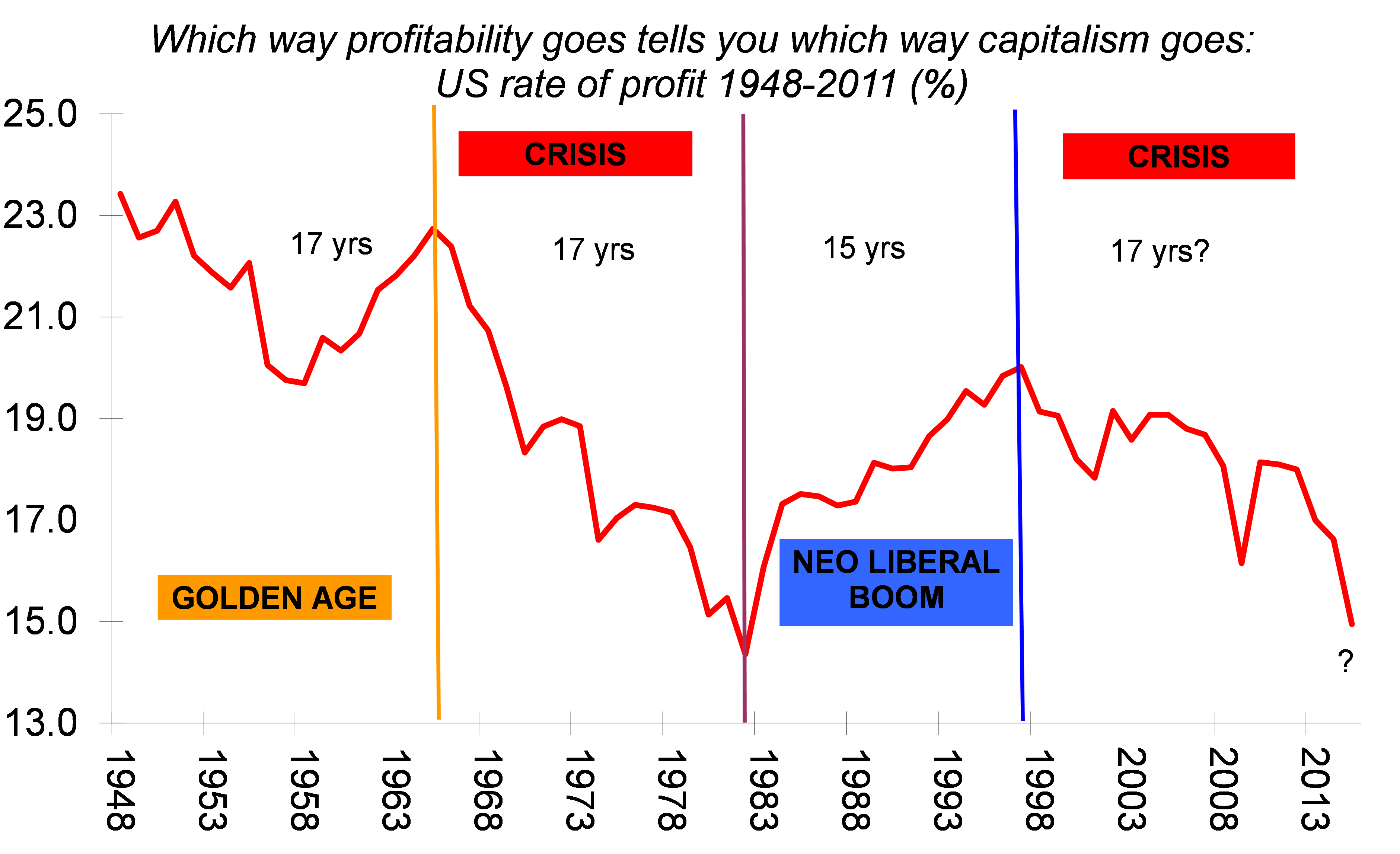
Michaels Roberts instead focuses on the rate of profit. Like Keen he believes that “there is always the possibility of crisis”. But as a Marxist he doesn’t see debt as the key driving force behind the slump.
The capitalist system of production for profit will falter if not enough profit is created to satisfy the owners of the means of production. And there is an inherent tendency for the rate of profit to fall. This is the underlying cause of all slumps.
[Capitalists] compete with each other to sustain and increase their profit. To do so, they make workers work longer or harder, but they also increasingly use new technology to boost the productivity of labour to get more value. But this is capitalism’s Achilles heel. The accumulated cost of investing in new plant, equipment etc inexorably rises compared to the size and cost of the labour force. As only labour can create new value (machines on their own cannot do it), the profitability of each new unit of investment begins to fall. If profitability falls consistently, eventually it will cause a fall in the mass of profit. Then capitalists stop investing and ‘go on strike’. A crisis of production ensues.
Capitalists try to top up their profits with new technologies, by exploiting workers more, and by gambling in new and more exotic forms of finance. The latter became particularly pronounced in the later years of the most recent crisis. Eventually, though, capitalists can’t buck the decline in the rate of profit. There are different ways of calculating profits but the following graph from Roberts shows that the rate of profit in the United States is running at one of its lowest points in the last 65 years, which is perhaps surprising given the story of relentless efficiency peddled in the media.
Source: http://thenextrecession.wordpress.com/
Roberts agrees with Keen that clearing the debt overhang is key to the restoration of growth, but he sees the mechanism as being via profitability, which must first be restored to kick-start investment and economic growth. Roberts is more pessimistic than Keen, arguing that another huge slump will be needed to cleanse the system of dead capital. I doubt he’d think a debt jubilee would be enough to get the economy going again.
In the end i’m not sure the two explanations are completely incompatible. Marxists and Keynesians like to pretend they are at loggerheads, but sometimes their analyses overlap. One key area in which they agree is that the conventional, neoclassical framework is completely inadequate for understanding the crisis — indeed neoclassical economics doesn’t really have a model of crisis, preferring to focus on equilibrium and static states rather than the ups and downs of the economy, which to me are the interesting bits. Some of the mainstream explanations of the crisis are laughable, as I wrote in this blog post:
According to some accounts, the likes of Bernie Madoff and AIG’s Joe Cassano caused the entire calamity themselves, flanked by the crony capitalists who stalked Wall Street. A few bad men infected the entire system. In a similarly individualist vein, Tyler Cowen said that Americans didn’t save enough and had taken on too much risk due to ‘investor hubris and collective delusion’. A bit of bad luck combined with poor governance to sink the economy.
These sort of explanations are ridiculously superficial. Of course a handful of men couldn’t have caused the entire crisis. Greedy people have always existed, and their influence varies at different times. Low savings rates and an appetitie for risk had an impact, but they aren’t anything like the whole explanation behind the crisis, and they can’t be seen in isolation, without looking for more profound causes.
Another thing that Roberts and Keen agree on is that debt ultimately precipitated the crisis and that deleveraging will take many, many years. Keen himself has written about what Marx called the “fictitious capital” created by “the “roving cavaliers of credit”. Roberts, though, perhaps believes himself to have identified a more profound process. For Roberts the creation of financial debt was only part of the overall process under which the capitalist attempts to identify new sources of profit, and must be seen alongside the increasing exploitation of labour and the search for new technologies.
I find Keen a bit more convincing on the immediate causes. The correlation between the change in debt and the jobless rate is so strong, and years beforehand Keen was, for good theoretical reasons, so vehement that the crisis was coming, that it’s difficult to dismiss his analysis.
Doubts about the labour theory of value aside, Roberts probably has the more convincing long-term story, but i’m doubtful about the predictability of the crisis based on the peak in profits around 1997. Why did the crisis happen in precisely 2007/8 and not earlier? Why the 11-year gap? Capitalism isn’t mechanistic enough to move in 15 to 17 year cycles. Economic behaviour is unpredictable, as I said above, and I am dubious about almost any analysis which talks of iron laws or long-term inherently stable relationships. That’s not to say that relationships can’t exist for a period of time, but attempts to predict exact timeframes are usually doomed to failure.
It’s also easy to get drawn into identifying single causes for the crisis, although neither Keen nor Roberts do this. Lots of causes accumulated at the same time — like globalisation; the inadequacies of the Bretton Woods system; the Big Bang; central-bank independence; overspending by Western governments. The interdependencies between these factors are the interesting points of analysis: for instance the rise in fictitious forms of investment and the surge in personal borrowing effectively helped interest rates to remain at historically low levels throughout the 1990s and into the next decade, facilitating Blair and Brown’s spending splurge and Bank of England independence, and in turn feeding the bubble. Debt and profits are fundamental, but they affected and were affected by many of the other processes.
Either way, both Roberts’s and Keen’s explanations of crisis are a welcome move beyond the conventional story. Any proper explanation of the crisis, and any new economics, if it is to be successful, needs to take into account not only the inherent tendency of capitalism toward crisis, but the methodological issues of reflexivity, uncertainty and multi-factorial explanation.

 Emergent Economics