Has spring sprung?
About 18 months ago I wrote a post called the Economics Spring which argued that the Keen/Krugman debate represented a tipping point in economics. So far my post is one of the most popular on Renegade Economist, with nearly 16,000 page views. It got a lot hits on my own site as well as a few retweets.
I wrote that: “Most economists failed to understand or predict the global economic crisis, and should therefore be deposed. Just as the despots of north Africa and the middle East crumbled in the face of a critical mass of popular opposition, so too mainstream economics is looking shaky in the fresh-faced glare of laymen.” Establishment economists have been so bad at understanding the crisis that a lot of knowledgeable outsiders look far more convincing — and their remedies better.
Krugman’s acknowledgement of Keen was unprecedented: Keen was a guy from a supposedly minor Australian university who wrote a demolition-job of mainstream economics over a decade ago which rejected almost the whole mainstream. Until last year he was completely unheard-of outside heterodox circles. Here he was having a bust-up with a Nobel prizewinner, one of the most-read economics bloggers.
But has economics really changed?
In some ways, yes. Keen continued to work the media circuit, winning lots of attention and securing funding for his Minsky dynamic monetary model. Partly because of his efforts, endogenous money, modern monetary theory and post-Keynesian economics are more prominent. The Real World Economic Review has 23,000 subscribers and its blog remains a go-to destination for questioning economists. The launch of the online open-access World Economic Review journal met with flood of sign-ups. There’s even a whole new institute dedicated to new economic thinking.
Krugman, surely one of the most exciting academic bloggers, continues to skirmish with the fringes, leading some to suggest that he is becoming progressively more radical. Three times this year the New York Times columnist has mentioned Michal Kalecki. Last week he said the neoclassical synthesis was breaking down: practically the equivalent of a Jew rejecting the Torah. His 2009 New York Review of Books essay said that the previous two decades of macroeconomics had been a “waste of time”. Later he called macroeconomics a “sorry spectacle of unnecessary ignorance”.
Duncan Weldon said that Krugman’s neoclassical synthesis post was one of the most significant blog posts on economics he’s ever read. In itself it’s a huge admission for a successful academic economist to admit that power, rather than the marketplace of ideas, dictates which theories become prominent. Next Krugman noted the decline of new growth theory, the next big thing when I was a student.
Other academics have similarly started to question the very essentials of mainstream economics. Here’s Mark Blyth of Brown University:
…a notion I used to give short thrift to but am really having to rethink this now – the old Marxist notion of the long run crises of overaccumulation and overproduction.
…
Now I teach [the Philips curve] every year and I have two slides. The first slide I use is the data from Britain in the 1970s that Milton Friedman used to calibrate this model, to prove it is right. It only has nine data points, I mean Jesus Christ it’s ridiculous – nine data points for a whole macro theory. But it does show this pretty nice pattern and we’ve been teaching this stuff ever since in every macroeconomics class. But the next slide I show is the data from Britain from 1992 to 2007. It’s based on twice as much data and it’s horizontal. So what does that mean? It means basically that the model is completely wrong empirically. It means that in fact you can have pretty much any level of unemployment you want and a constant rate of inflation, which is actually the world we live in now.
So what is the first function of economic knowledge? It’s prejudice. It teaches you to think about the world in a certain way so that your bottom line response is: no you can’t do that because of the Phillips curve. Government action is pointless and will only produce more inflation.
Never mind the lefties; the crisis already prompted a catalogue of mainline economists to question tenets of the mainstream, people like John Kay and former Bank of England monetary policy committee member Willem Buiter. It seems like not a month goes by without a press article lamenting the state of economics.
But do a few newspaper pieces, blogs and retweets make any difference?
Maybe not: the curricula and journals show little sign of changing. The latest issue of the American Economic Review features such page turners as: “Does Disability Insurance Receipt Discourage Work? Using Examiner Assignment to Investigate Causal Effects of SSDI Receipt.” (The answer: yes, mostly). The Quarterly Journal of Economics has a ground breaker on: “Rules with Discretion and Local Information.”
The Harvard undergraduate economics guide continues to take the very standard view that:
An economic analysis begins from the premise that individuals have goals and that they pursue those goals as best they can. Economics studies the behavior of social systems – such as markets, corporations, legislatures, and families – as the outcome of interactions through institutions between goal-directed individuals.
The syllabus follows the classic, mainline perspective, with no requirement to study the history of economics or the history of economic thought, let alone contemporary economics traditions other than the neoclassicals. Harvard is probably representative of most universities, despite a walk-out two years ago by students who said that their course pushes a “strongly conservative neoliberal ideology.” In this they echoed a 2003 Harvard petition and the earlier French post-Autistic student movement, which criticised the neoliberal stance of the mainstream.
But as Krugman says, maybe the malcontents don’t need to bother with the journals any more.
…the amount of good stuff — stuff delivered in real time, on blogs open to anyone who wants to read rather than in the pages of economics journals with a few thousand readers at most — is amazing. When it comes to useful economic analysis, these are the good old days.
In several cases — Syria aside — the Arab spring wasn’t a wholesale confrontation of power; it was a gradual simmering-to-the-surface of widespread discontent. New media like Facebook and Twitter helped fan the flames. Often, true revolutions occur when radicals subvert the status quo and simply start doing new things in new ways. Without wishing to sound like a dedicated follower of Foucault, trying to fight power structures only tends to reinforce them. You’re never going to beat an army.
Economics is a constantly mutating phenomenon, and it’s quite difficult to define exactly what it is or what the ‘mainstream’ is. Deirdre McCloskey prefers the term ‘post-Samuelsonian’. Even the term neoclassical presents difficulties — does it include recent developments like behavioural or experimental economics? Some don’t even think that the economics of information for which the likes of Stiglitz and Akerlof got their Nobel prize is mainstream. Even self-declared new Keynesians like Krugman, Stiglitz and Mankiw have thought of themselves as outsiders. I’m not sure that Krugman is quite the upstart that some seem to think. Dropping a few marginalised names does not a radical make.
Some fringe economists despair the slipperiness of the mainstream, but diversity and fragmentation are surely assets. It’s just about conceivable that the current academic journals and courses will become more and more irrelevant and that questioning, knowledgeable outsiders and critical students will simply walk past the academic gatekeepers into new, pluralistic territory which reflects the ideas of the whole world, not just Europe and the United States — and where no single method dominates. People will increasingly surf the Internet and find out for themselves. The big questions, in my view, are to what extent the open economics of the blogosphere and web will supersede the paid-for paper journals, and whether new ideas start filtering through to policy. If the rest of the world is anything to go by, the future is bright (with a few cloudy spells).
Kalecki said other things, too
Mainstream economists periodically rescue authors from what they see as the economic graveyard. The latest exhumation is of Michal Kalecki by Paul Krugman.
Quoting from Kalecki’s well-known essay Political Aspects of Full Employment, Krugman in his latest New York Times column tries to understand why companies might oppose full employment during a downturn.
Wonder of wonders, Krugman quotes Kalecki http://t.co/hqB0DYQkO7 An entire PhD could be written on the slow radicalisation of The Krug
— Aditya Chakrabortty (@chakrabortty) August 9, 2013
Opposition to government spending seems counter-intuitive because you’d think businesses would want the economy to recover so that they could raise profits. Kalecki’s answer was that bosses understand that job-creation would undermine their influence:
In the great depression in the 1930s, big business consistently opposed experiments for increasing employment by government spending in all countries, except Nazi Germany.
…
The attitude is not easy to explain. Clearly, higher output and employment benefit not only workers but entrepreneurs as well, because the latter’s profits rise. And the policy of full employment outlined above does not encroach upon profits because it does not involve any additional taxation. The entrepreneurs in the slump are longing for a boom; why do they not gladly accept the synthetic boom which the government is able to offer them?
…
Every widening of state activity is looked upon by business with suspicion, but the creation of employment by government spending has a special aspect which makes the opposition particularly intense. Under a laissez-faire system the level of employment depends to a great extent on the so-called state of confidence. If this deteriorates, private investment declines, which results in a fall of output and employment (both directly and through the secondary effect of the fall in incomes upon consumption and investment). This gives the capitalists a powerful indirect control over government policy: everything which may shake the state of confidence must be carefully avoided because it would cause an economic crisis. But once the government learns the trick of increasing employment by its own purchases, this powerful controlling device loses its effectiveness. Hence budget deficits necessary to carry out government intervention must be regarded as perilous.
The “state of confidence” argument, it goes without saying, is nonsense. It’s just a ploy to stop people from supporting public spending to boost employment.
Krugman first blogged about Kalecki in May 2013 (h/t David Spencer), saying that he had been “reminded” (code for “read for the first time”) about Kalecki’s essay two-and-a-half years previously via a blog by Mike Konczal: one of those respected gatekeepers who you’re allowed to trust, unlike the hundreds of less-public academics who’ve been writing about Kalecki for decades.
It’s not clear that Krugman has read much else of Kalecki, although he does note that he was a naughty Marxist. Chris Sturr points out that “liberals like Krugman… go out of their way to distance themselves from Marx and Marxists (“I don’t see much of Marx in his writings”), lest anyone think they are flaming radicals.”
Krugman might have seen more of Marx if he’d read the rest of Kalecki’s essay:
Indeed, under a regime of permanent full employment, the ‘sack’ would cease to play its role as a disciplinary measure. The social position of the boss would be undermined, and the self-assurance and class-consciousness of the working class would grow. Strikes for wage increases and improvements in conditions of work would create political tension.
It’s hard to see a New York Times columnist writing about class-consciousness or strikes with anything other than a sneer. But you’d at least think that Krugman as academic might make some sort of attempt to convey the wider context of Kalecki’s writings.
That he doesn’t is perhaps because Kalecki’s approach completely opposes the neoclassical tradition from which Krugman hails. Kalecki thought that the assumptions of a model should be realistic. He never used the concept of utility. Equilibrium, for him, was a fiction. He disputed marginalism and rarely used the idea of supply and demand. He thought that analysis should take place at the level of the social class rather than the individual.
Unlike the physics-envious mainstream of economics, Kalecki didn’t think that “solutions” were ever likely, suggesting that analysis should vary according to time and place. What worked in India might not work in Cuba. He believed firmly that politics and power were important, unlike the neoclassicals, who imagine themselves to be neutral scientists labouring in the background to present a range of objective answers to politicians.
Despite pre-empting Keynes’s notion of effective demand by several years Kalecki opposed blanket Keynesianism. In his Essays on Developing Economies he wrote that developing countries are often not limited by a temporary shortfall in demand but by a permanent deficit of capital. Developing countries don’t have enough capacity to be able to produce things, so the task of development should be to industrialise using government and outside help and to improve the use of technology.
Mainstream economists are often accused of ignoring alternatives. But they sometimes do rock down to eclectic avenue, as Eddie Grant never sang. They occasionally mention the heterodox in their writings, making it look like they are open to all kinds of ideas and that the mainstream constantly accommodates the fringe. This allows them to portray the rest of the fringe as lunatic and to dismiss it. So the apparent open-mindedness of Krugman and his ilk is actually conservative, enabling conventional economics to lumber onwards.
The study of political economy, like any other social science and any way of looking at human relations, is characterised by disagreement; by differing thought-systems each with their own merits and problems. Sometimes these thought-systems have to be considered in their entirety. It’s not always useful to pick the parts you like and to ignore the others. I can’t see how you can quote Kalecki on public spending and ignore his entire methodology. It’s a bit like Krugman on Keynes’s General Theory: he likes the parts about government spending but not the stuff about uncertainty and expectations.
Another example is Hyman Minsky. Everyone suddenly had their Minsky Moment in 2008 – but by then it was too late. A full understanding of Minsky’s vision of capitalism – as an inherently unstable if not non-viable system which tends to become unduly dominated by finance – would have alerted many in advance to the fact that the boom was unsustainable, rather than allowing them retrospectively to claim that they understand the crisis. A deep comprehension of Minsky would have required a vision of economics that was different to that of the mainstream, which sees capitalism as essentially stable and analytically understandable using techniques of equilibrium.
People can be eclectic if they want, but if their cherry-picking somehow further marginalises the margins, then in effect the whole exercise is more monolithic and less conducive to diversity, despite appearances.
So Krugman’s Kalecki moment doesn’t truly represent his progressive radicalisation and it’s unlikely to advance our collective ability to predict future economic outcomes using Kalecki’s methods. It’s just another example of the selective quoting of alternatives whenever it suits. Paradoxically, the periodic resurrection of radicals suppresses their broad insights.
Economics is personal, whether we like it or not
I love to read a bit of name-dropping. A fine example thuds on to the page at the start of the latest piece by Raghuram Rajan on the public spat between Paul Krugman and Reinhart and Rogoff:
For those who know these two superb international macroeconomists, as I do…
He’s trying to argue that the metaphorical punch-up, which was about whether or not too much public debt causes economies to slow down, should have between conducted entirely calmly and free of vitriol. Rajan believes that nobody can be so sure of their position that they should dig their heels in quite to the extent that Krugman, Reinhart or Rogoff did. “Economics is an inexact science, with exceptions to almost every pattern of behavior that economists take for granted”.
But Rajan’s shameless self-propagandising-by-association somewhat undermines his argument that economic debate shouldn’t be personalised.
Rajan makes the curious point that: “Perhaps respectful debate in economics is possible only in academia.” Last time I checked, most academia was so infested with infighting that it made the UK House of Commons look like the picture of restraint.
All social science starts from a subjective, unstated position. It just isn’t the neutral, value-free discipline that its physics-envious mainstream practitioners pretend. Economic behaviour is unpredictable and complicated, so those who study it are hardly likely to achieve a consensus. This is a point which Rajan himself recognises:
economic behavior is complex and can vary among individuals, over time, between goods, and across cultures. Physicists do not need to know the behavior of every molecule to predict how a gas will behave under pressure. Economists cannot be so sanguine.
…what seem like obvious, commonsense policy solutions all too often have unintended consequences, because a policy’s targets are not passive objects, as in physics, but active agents who react in unpredictable ways.
As Deirdre McCloskey said long ago, economics is rhetoric. Like all social sciences it’s a process of trying to convince others of the validity of your position using all the techniques at your disposal. So a statistical regression doesn’t “prove” a theory to be true or false — it’s just evidence (albeit maybe very good evidence). A clever model doesn’t provide an “answer”. It simply posits that, under certain circumstances, a particular relationship might hold. All sorts of hidden or clearly stated assumptions underlie any model.
The inevitably rhetorical and inexact nature of economics, not to mention its dependence on values, means that it is always likely to be personal. It’s a human belief-system whose outcomes are destined to be all-too-human. It’s almost impossible for economists or any other social scientists to progress without developing a set of beliefs about how the world works, and these beliefs are likely to be based on personal experience and political persuasion. That’s why Krugman and Reinhart and Rogoff shout at each other so loudly. Rajan is so keen to tell readers that he is mates with a Nobelist and two academic superstars because he wants to persuade us that he’s a bigshot who’s worth listening to.
Nothing wrong with that — we’re all trying to convince. Power always enters into the equation. But it would be a good idea to admit the rhetorical nature of economics as well as its non-neutrality. Economists should probably state their assumptions and try to make clear what biases they bring to their research.
I actually find it slightly creepy that economists would try to portray themselves as white-coated scientists tinkering behind the scenes, especially when such monumental political decisions are at stake. It’s no bad thing that some debates are conducted in public, even if a bit of snarkiness creeps in. And in the end who doesn’t like watching a bit of a brawl?
If only economists were remotely close to following Rajan’s advice:
All of this implies that economic policymakers require an enormous dose of humility, openness to various alternatives (including the possibility that they might be wrong), and a willingness to experiment.
What caused the economic crisis and what are the biggest problems currently facing the developed economies? Years of over-investment and the uncontrolled explosion of exotic financial instruments in the boom years created a surge in personal and corporate debt – the latter mostly accrued by banks and financial institutions.
The whole process was facilitated by historically low interest rates, over-dependence on the financial sector and intimate links between Europe and US banks, which meant that when one stumbled, entire economies were dragged down. A decline in real wages over the past five years against the backdrop of a long-term decline in the wage share of the economy has supressed demand.
Rich-country governments have been forced to socialise socialised the fallout from these private-sector calamities and maintained spending during the downturn to compensate for the slump in demand, raising public debt. Contrary to the idea that austerity is reducing the need to borrow, government debt in every advanced economy has increased since 2009, according to the Bank for International Settlements.
What would be an example of a healthy economy, one which was poised to recover well from the global crisis? Well, one which was growing, for a start, and which has expanded in recent years — unlike the UK economy, which is still smaller than it was in 2008. A steady 3.5% GDP growth, for example, would be nice this year. An unemployment rate of, say, 7.2% would suffice, especially if living standards were maintained as wage increases kept pace with inflation.
But growth and a relatively high employment rate would be no use if public debt was strangling the economy. A public debt ratio of about 35% of GDP would be lovely – around a third of the ratio in the UK. A healthy economy might have to run a temporary deficit to maintain demand in a sluggish global economy, but it could probably be tolerated if this were its first since the mid-nineties, and if the economy were growing fast enough to maintain revenue growth.
Foreign debt can be particularly destabilising, as Italy, Ireland, Spain and Portugal have found out. Probably better to keep it low to reduce the influence of the bond vigilantes. A rate of 14% of GDP would be the envy of many governments.
An additional sign of health would be an economy which was diversified and which had a manageable financial sector. A lack of dependence on the rest of the world would reduce exposure to overseas wobbles. A country lucky and big enough to produce lots of stuff at home wouldn’t have to trade as much, boosting the prospects of a trade surplus.
As you might have guessed, this healthy economy isn’t fictional. Unlikely as it might seem, it’s Argentina, a country which outperforms most European countries and the US on almost every critical macroeconomic indicator – public debt, foreign debt, GDP growth, unemployment and the budget deficit (which was recently reported at 3.2% of GDP).
The economy runs a trade surplus, and trade in goods and services is a small proportion of GDP even though the country is a major agricultural exporter. The country has a small but functional financial sector featuring some foreign banks, although finance is a far smaller part of the economy than in a country like the UK, which Nicholas Saxson and John Christensen have described as being cursed by finance.
During the last decade Argentina enjoyed its fastest ever period of economic expansion, at a real annual average of 7.3% according to World Bank figures, one of the highest rates in the world during that period.
Given all this positive data, particularly on debt, you’d think the economy was better placed than most to deal with the aftermath of the crisis.
Yet the foreign press and the International Monetary Fund are far from satisfied. The government is constantly slated over inflation. In February Argentina became the first country ever to get a rap on the knuckles from the IMF for allegedly faking its price numbers. An official rate of 10% is far lower than the 25% calculated by private-sector economists.
Debt-holders are suffering as the value of their future repayments is eroded. Inflation presents a big problem for the poor, and the government has tried to combat this effect by negotiating a deal with the major supermarkets to keep prices on hold for most of 2013.
Partly as a result of worries about Argentina’s fiscal situation, benchmark interest rates have been driven to very high levels, currently 13.25%. But this is slightly less important than in a country with a big debt pile. Strict controls have also been brought in to stem capital flight.
In no way is this to suggest that Argentina’s economy is a stellar performer – it’s got a history of financial mismanagement and political instability. Hyperinflation hit 12,000% in 1999. A lot of the numbers are so positive now simply because the economy sank to such a catastrophic low in 2002 after the debt default.
President Kirchner has yet to find a way of taking full advantage of the massive natural reserves of oil and gas, not to mention agriculture. Productivity has risen in the last 10 years but it still lags competitors, and investment, particularly in infrastructure, is generally low as political instability deters long-term players.
But undue attention is placed on inflation. As a recent OECD report puts it: “the risk of repeating another episode of hyperinflation is low in Argentina, at least in the short-run. Previous episodes of hyperinflation were associated to [sic] high government deficits that were monetized and to capital flight that forced a sharp reduction in the value of an overvalued Argentine peso. This is not the case today.”
The inflation-mania of the international business press is partly to do with its unstinting orientation toward finance. Rather than analyse the economy as a network of transactions for the provision of welfare to the people who live in it, these institutions tend to view economies only as places to conduct short-term investment – and short-term investors generally don’t like inflation.
Using a standard formula which sees anything that is bad for investors as bad for the economy, the business press panics at any sign of deviation from the Washington Consensus. Anything other than total private ownership of business, current-account and capital account liberalisation is anathema.
So the nationalisation of oil company YPF last year, for example, was greeted with jeers from the foreign media and yet more derision when the government sold part of the company to Chevron last month for a sum big enough to bring state finances back to supportable levels. Capital controls are slated, even when they work. Import tariffs and the promotion of domestic production are likewise seen as poison to the international financial class.
Wall Street is still smarting from the late 1990s when the emerging-market debt boom made Argentina a place of unheralded money-making opportunity, followed by the inevitable burnt fingers when the boom ended. The largest public default in history hurt a lot of investors, and they appear reluctant to forget it.
Yet Buenos Aires does have a strategy, one of growth, industrialisation, a degree of import-substitution and the protection of certain sectors from foreign competition. Unlike previous governments the Kirchner administrations have paid attention to the poor, bringing the official poverty rate down from a half of all families a decade ago to around a tenth now. Whether or not the strategy will work in the long run is unknown, but at least it’s a strategy that’s proved viable since 2003.
Given the travails affecting the rest of the world, you’d think that an economy with Argentina’s economic fundamentals had a chance of weathering the storm. It’s at least possible to construct a moderately positive story about the economy, although this rarely happens. You might even go as far as to draw conclusions about finance and debt for the developed economies of Europe and for the US.
Could it even be that the ultra-liberal, finance-dominated economic model of Europe and the United States is bust, and that a more statist, egalitarian model has a better chance of success in the post-crisis world?
Trade is about politics, not just economics
A great post by Unlearning Economics on the site Pieria argues that ‘free trade’ is a myth. Both proponents and opponents miss the point that markets are built rather than natural, and that they depend on politics, not some sort of standalone economic process.
As is common in economics, I can’t help but feel this debate is being conducted on a phoney dichotomy: between the state and the market; managed or non-managed trade; politics or economics. All too often there is the idea of an implicit ‘free trade’ baseline, and one side argues for it while the other suggests strategic interventions to steer trade in the right direction.
As I pointed out in a post a couple of years ago, some of the Wikileaks revelations showed that trade is political, and has nothing do with comparative advantage.
My work on trade policy in developing countries strongly confirms this view. For instance in the tiny, isolated island nations of the Pacific, trade is built on ancient colonial relationships, modified in recent years by the influence of more powerful political interests such as those of big neighbours Australia and New Zealand.
The Pacific island nations mostly specialise in a few agricultural commodities, fish and coconuts, as well as tourism. To an extent you can argue that these are the countries’ comparative advantages — what they’re domestically better at producing relative to production of other things.
But that statement doesn’t really mean much. Britain and France, which used to own most of the Pacific before independence in the 1960s-70s, used it as a resource base for export to their own countries. That’s partly why these countries have lingering, entrenched agricultural sectors with limited value-addition. It certainly isn’t in their development interests to continue specialising in copra, which is one of the lowest-value products, or to keep exporting fish from their seas without processing it onshore. Pacific island nations are mostly too small and inflexible to industrialise, and they lack the human resources or land area to be able to quickly move into conventional, more value-adding sectors.
Nowadays the European Union is washing its hands of its former colonies around the world by obliging them to take part in a series of trade deals known euphemistically as Economic Partnership Agreements, which redefine their trading relationships as being reciprocal, meaning that any concession the EU makes, like a preferential low tariff rate, must now be given back to the EU in return. Brussels is no longer prepared to defend a special waiver for African Caribbean and Pacific countries at the World Trade Organisation which allowed the EU to violate the Most Favoured Nation rule, which is supposed to accord one country or region treatment no less favourable than another.
For similar reasons Australia and New Zealand are also prodding the islands in the direction of new trade deals — the Pacific Agreement on Closer Economic Relations (PACER) and PACER Plus. It’s nothing to do with direct commercial interest, just the new realities of the global economy and the need to set a precedent for other, more lucrative trade deals, such as those with Asian countries. There’s an element of ideology at work too. ANZ trade officials think that all countries should do ‘free trade’ because it works for them. They forget that their own countries developed under strong protectionism.
Neither of these deals make much development sense. The Pacific islands have already long had duty and quota-free access to Europe and ANZ. Why shouldn’t they be allowed to keep it? And it’s up to the islands to decide what tariff they impose on the goods of foreign countries.
In fact if trade agreements were really anything to do with the simple ideal of ‘free trade’ or direct economic interest, the Pacific islands wouldn’t be engaging in time-consuming, technical and troublesome deals with the EU, Australia or New Zealand at all, since the islands are increasingly trading with Asia. The following graphs show the historical direction of exports and imports in the Solomon islands since 1980.


Source: IMF direction of Trade Statistics
China has become by far the biggest export partner, although its share is now dwindling. Exports to the EU have steadily dwindled since the 1980s. On the import side, developing Asia is the big story, and Singaporean imports have similarly risen strongly, while Australia is currently the second-biggest import partner by country, although with a volatile history. Measured by both exports and imports, the EU is the country’s smallest trading partner.
So why aren’t the Pacific islands striking deals with Asia? If trade policy were about some sort of neutral pursuit of economic interest, the islands wouldn’t be wasting their time with the EU and ANZ; they’d be looking north and nearer east, and they’d be thinking about new opportunities in technology and services. But as it happens the current big powers with lots of political clout have decided that they want to do trade deals with the islands, and what they say, goes. China and Asia have very little trade interest in a region as tiny as the Pacific — its collective GDP is about the size of a mid-sized European town.
If I had a slight criticism of the Unlearningeconomics article, i’d say that she or he neglects the vast lobbying power of corporations and the extent to which trade deals are a product of the shoutiest multinationals. It’s a mistake to think of countries as necessarily acting in the interests of their citizens. The Wikileaks cables show that the United States acted quite clearly in the interests of McDonalds in El Salvador, partly due to powerful lobbying. The US also intervened behind the scenes in the interests of Monsanto and genetically-modified foods in Europe over many years. This had nothing to do with the comparative advantage of the United States or what was good for Americans.
But overall Unlearningeconomics is right:
The reality of trade is that it is always, necessarily, regulated. There is no ‘free’ baseline, untouched by politics, history and culture, to which we can aspire.
Trade is always managed, implicitly or explicitly. We can pretend that this isn’t the case and pursue an ill-defined ‘free trade’ ideal, allowing powerful interests and luck to shape the nature of the global economy, perhaps to the detriment of many. Alternatively, we can bring the management of trade into the open, making trade decisions political choices subject to public and professional scrutiny, respecting each country’s unique needs, and making sure that countries cooperate instead of descending into economic – or worse, real – conflicts.
From the comments section of an article in the Torygraph which expresses scepticism about 3D printing:
“My company has recently acquired a 3D plastics printer for £26K and it’s slashing the time it takes to make components for automated machine builds from weeks to hours. Admittedly the components are used in less critical areas and yes the materials are limited. But in 15-20 years time the material variety and precision will be addressed. It will never replace high volume manufacturing, but for small scale/volume engineering it could become the mainstay. Metal 3D printing is also well established.”
All sorts of materials can now be used for 3D printing: rubber, silicone, food, etc. I’d say that material variety and precision will be addressed sooner than the commenter thinks.
Beam me up Scotty
People often speculate about how long it will be before Star Trek-style teleporting becomes reality – ie. the instantaneous beaming of people and things from one place to another thousands of miles away. Well, we won’t be standing in shower cubicles like Spock for some time. But in effect physical things can already be teleported.
As I mentioned in my last post, three-dimensional scanning and printing has made international trade in things – ie. the physical shipment of goods – potentially obsolete. Designs for almost anything can be emailed, downloaded or scanned and printed on location in 3D.
The following video shows an adjustable spanner being scanned and printed in an hour and a half.
Services can be already be traded online – but the virtual trading of goods will have a potentially revolutionary effect on economies, and one which has still to be understood. The reduction of shipping costs will also have significant environmental implications.
Several groups of developing country might benefit. About 29 nations are unofficially classified as small island developing states by the United Nations. A further 31 are considered landlocked and developing, most of which are small by population and economic size. That’s 60 countries – almost a third of the world’s total. Admittedly it’s not a third of the world’s population – most poor people live in China and India – but it’s a fair chunk.
Other countries will benefit too, and possibly in significant ways, although it’s among the nations marginalised from trade that I think there is most potential. These economies tend to grow more slowly because they face higher import and export costs, which result from the need to transport things either a long way by sea or across other countries.
Small island developing states are more dependent on trade than low income countries, according to the World Trade Indicators, with goods and services trade making up an average of 128% of income-weighted GDP. That’s largely because these countries can’t make much at home. Their imports and exports are less diversified by product and destination (with a higher Hirchsman-Herfindahl market concentration index for imports and exports by product and destination compared with low income countries). These countries will never produce in large volumes or achieve economies of scale because they aren’t big enough and don’t have enough people or capital.
A country like Vanuatu, for instance, spends about US$242 million on imports every year, which is about a third of GDP. Of this, 56%, or around US$135 million, is manufactures. In a very far-fetched world a considerable proportion of this sum could be substituted by locally printed products. All that would have to be imported is the powders and polymers for use in 3D printers, which would be smaller and more easily transported. Similarly the currently tiny volume of exports could be boosted by niche, locally-produced printed products. The impact on the economy could be enormous, potentially reducing the chronic imbalance on goods trade. The country has run a visible trade deficit during every year since independence in 1979.
Admittedly much of this is science fiction, but it’s not ridiculous to imagine a world in which pretty much most processed goods other than staple foodstuffs are printed. Even foods can be processed using 3D printers.
I’m not sure many people realise quite how the dire state of domestic production and diversification is in many isolated developing countries. Typically they produce one or two commodities, often with low or zero processing and limited diversification by destination. Usually these countries depend on trade preferences. Landlocked Lesotho’s garment industry, facilitated by the US AGOA trade preference system, is almost the sole major source of exports – and it depends on a large annual government subsidy. Haitian exports are almost entirely made up of T-shirt sales to the United States under the HOPE II trade scheme. Annual exports from a new nickel mine in Solomon Islands will alone be worth two-thirds of GDP.
The economic structure in these countries is severely inflexible, limiting the possibilities for the conventional process of industrialisation. But with the development of 3D printing there would be no need to produce in large volumes – no-one should ever seriously imagine that small island developing or landlocked states will develop on the basis of mass export-based industrialisation like East Asia did. Set-up costs for Maker workshops are pretty minimal — potentially a few thousand dollars – and labour costs reasonably small in the early stages.
Could you potentially see a cluster of infant cottage industries catering to local demand? The main problem with import substitution industrialisation was that it encouraged low-quality domestic production, given that companies were shielded from international competitive pressures. Giant, old-fashioned companies producing shoddy goods – the classic example is Brazilian cars – became the standard.
But with the reduction in the cost of design and the increase in open-access software and hardware, via the Internet, access to cutting-edge international designs has become free. There is no need to make sub-standard products. Small developing countries can potentially produce to the highest standards.
A key problem in small island and landlocked developing states is that their lack of economic diversification makes them vulnerable to international shocks. Contrary to the classical theory of comparative advantage, economic development is a process of diversification, not specialisation. A cluster of workshops printing a range of goods would spread production across a range of areas, helping shield the economy from wobbles in the international economy.
What trade policy would need to accompany the shift to additive manufacturing? Maybe higher tariffs on finished products wouldn’t be necessary because the natural rate of protection due to vastly reduced transport costs would be so significant. It might be necessary to lower input costs by reducing tariffs on the inputs necessary for printing. But import volumes would surely be slashed. A single container of inputs, packed solid and limiting space wastage, could potentially result in production many times greater than a container of a finished item.
As I say, most of this might just be speculative science fiction, but if Chris Anderson and the Economist are to be believed, we may be looking at a new industrial revolution.
Makers
Any volume whose front cover trumpets a review by GQ hailing it as “the business book to read right now” is probably one to avoid. But Makers: The New Industrial Revolution, by Chris Anderson, isn’t quite as irritating as you might think.
It’s about the upsurge in small-scale engineering, electronics, robotics and three dimensional printing currently underway in parts of the United States and Europe. “The past ten years have been about discovering new ways to create, invent, and work together on the Web. The next ten years will be about applying those lessons in the real world,” writes the former Wired editor, who quit his job last December to become a full-time Maker and entrepreneur (a combination which will doubtless be shortened to an ugly composite like Makerpreneur).
The advent of affordable 3D printing, which I wrote about a year ago, has made it possible to make a range of consumer items on a small, relatively cheap ($1500) 3D printer using free open-source designs from websites like makerbot and thingiverse.
I’m particularly interested because the technology has the potential to revolutionise trade in low-income island states and other peripheral places, reducing imports and vastly lowering the cost and scale of basic manufacture, not to mention the input costs of production for many processed goods. Car parts, toys, dental products, tools and even food can now all be printed in a small workshop or at home.
As 3D printers and the associated paraphernalia improve and fall in cost, there will be increasingly less reason to import stuff thousands of miles on expensive ships from China. Using a printer like the MakerBot 2 you’ll be able to make things wherever you are — just like you press print on Microsoft Word, only in more than one dimension.
Anderson even argues that the advent of the 3D printer, 3D scanner and CNC cutter have abolished the need for economies of scale. “Digital manufacturing levels the playing field. Any country can make things.” Until now scale been one of the key obstacles to development in small developing states. But they can now produce and even export at a fraction of previous costs. Trade will increasingly take the form of design and knowledge, or bits, rather than physical objects (atoms), further helping remove one of the main economic challenges for small island developing states: distance.
This might be wishful thinking: governments in small developing islands or other similarly marginalised states generally aren’t enlightened enough to act quickly to promote new Maker industries. They’re still stuck in the “hire consultant -> promote old-school manufacturing -> ignore the services sector” line of thinking. A lot of small, poor countries I’ve worked in (with a few exceptions, like Cape Verde) are still waiting for something like the 1970s electronics manufacturing revolution to land like a bolt from the sky.
The book is, of course, rammed with cant and hyperbole. Anderson reckons the Maker movement will be bigger than the Internet. I reckon his ego is probably bigger than God’s. The idea that technology will topple the behemoths is so 1990s, and the dominance of the web by three big companies — Facebook, Apple and Microsoft — suggests that powerful big companies have a habit of buying up new upstarts and trampling on their territory.
Hundreds of small workspaces have already launched in Shanghai to take advantage of the increasing trend to print your own 3D stuff, and they can probably do it much more cheaply and better than you can, even if they ship it from the other side of the world.
But beyond all the breathlessness there’s a kernel of truth, which is that the Internet is moving beyond bits and towards things, and that this trend will probably alter manufacturing for ever. This might just be a good thing for small, marginalised countries, and even more importantly, for the poor people who live in them.
A Thursday in Santa Clara
When flight AFL150 arrives in Havana today without Edward Snowden, a bored press pack will no doubt turn their attention to the evils of Cuba, Ecuador and Venezuela.
Towards the end of our trip across Cuba last year we stopped in Santa Clara, site of the decisive battle of the revolutionary war in which Che Guevara famously derailed an armoured train and overthrew the last Batista stronghold.
Nowadays Santa Clara is an unprepossessing town. We left an almost deserted motorway and followed a series of narrow streets. Crossing a dirty river we reached a large plaza with a scattering of trees and the customary horde of tourist touts.
After spurning their advances we made our way to a recommended casa particular (bed and breakfast) run by Terisita, a charming lady in her early 50s. We were intrigued to discover that Terisita had recently returned after a decade in Miami.
She “didn’t like America”, she said, because it was too expensive and unfriendly. She couldn’t afford treatment for her arthritis or diabetes and she didn’t see any prospects for old age. Her dad, at the age of 80, has to work as a cleaner in a condominium “for rich people”.
Each Cuban doctor serves only 150 individuals, the lowest rate in the world and much lower than the ratio of 416 in the United States. Cuba’s infant mortality rate of 5 per 1000 live births is the lowest in the Americas. Primary healthcare is considered particularly advanced because many doctors work without high-tech equipment and make diagnoses based on close interaction with the patient.
Our conversation with Terisita was mostly in Spanish, admittedly faltering on our part. Terisita said there’d been no need to learn English in the States because entire neighbourhoods comprised immigrant Latinos. Shopping, socialising – all in her native tongue.
She’d come back, she said, not just because she would get treatment for her ailments but because she felt happier.
Even in an economy suffering under the half century-old United States trade embargo, there are no slums and very few homeless people. Though the revolutionary ethos is dwindling, community spirit prospers, driven in part by local Committees for the Defence of the Revolution. There is a tangible sense that workers will strive toward the common good irrespective of material rewards (which is just as well because pay is very low. Doctors, for example, earn about £18 a month).
Cultural headway has been remarkable. Before the revolution in 1959 “culture” consisted of American gangsters visiting casinos and brothels in Havana.
Eleven ballet companies have since launched across the country, and Cuban dancers tour the globe. We watched a rehearsal in Santa Clara’s main plaza in which young children – again black, mixed-race and white – danced traditional ballet and modern arrangements in front of an enthusiastic crowd.
Later at a Rodriguez classical guitar concerto locals paid 10p; us about £2.50 each. Two of the four conductors were women. What a stark contrast to the UK, where in September Marin Alsop will become the first woman ever to conduct the Last Night of the Proms.
In Santa Clara one of the astonishingly adept soloists was a man, the other female. The orchestra was almost exactly divided along male and female, black, white and mixed-race lines – not because of political correctness but because gender and race genuinely appear to be unimportant.
Next door over a mojito we watched an ageing band turn out Jazz numbers to a local audience. Given half a chance Cubans will dance with abandon, not in a drunken individualistic way like an average European, but with finesse and smiles, and actually touching their partners.

And all this was on a Thursday, before we’d even visited the Che Guevara memorial, where he is buried in a shrine alongside his comrades who fell in Bolivia. Along the way we spent half an hour inspecting murals painted on a white wall. In one picture a group of marines erect an oil well in the desert, its tower flying the American flag. In another, a US soldier firing a gun runs along a conveyor belt marked “Vietnam, Yugoslavia, Afghanistan, Libya”.
What Terisita was implying was that equality and community have intrinsic benefits beyond just the moral imperative to look after the worst-off. Disbarred from economic growth by its northern neighbour, Cuba has been forced to seek progress in other ways. Health, education and cultural advancement have been among the biggest achievements of the revolution. Art, ballet, music – all are world class, which is partly why community spirit thrives.
There’s a certain irony in the fact that Snowden, in his campaign for transparency, will land in a country with only three national newspapers, all run by the party. But one of the great things about Cuba is that locals and visitors can enjoy a vital cultural life. And that’s a remarkable success in the face of seemingly intolerable international pressure.
Argentina: saviour or scoundrel?
The latest bout of Argentina-whacking is to be found in Foreign Policy magazine, the Pravda of the airport lounge-dwelling American CEO. The 1000-word rant is tacked to an opening paragraph accusing Argentina of passing a law last month which invites criminals to launder money.
In the next sentence the author Douglas Farah admits: “That’s not, of course, the official plan.” In reality the government is effectively holding an amnesty for people who formerly misdeclared their tax, letting them invest hidden hard currency in building projects and the state oil company. The law is designed to bring much-needed dollars back into circulation.
The move smacks of official anxiety but it’s not disastrous either – and it’s normally the sort of liberalisation that the magazine loves.
Possibly sensing the shakiness of his position, the author goes on to squirt his vitriol across a wider target. President Cristina Kirchner has created “chaos” – that catch-all tabloid buzzword – and “shortages” (no mention of what).
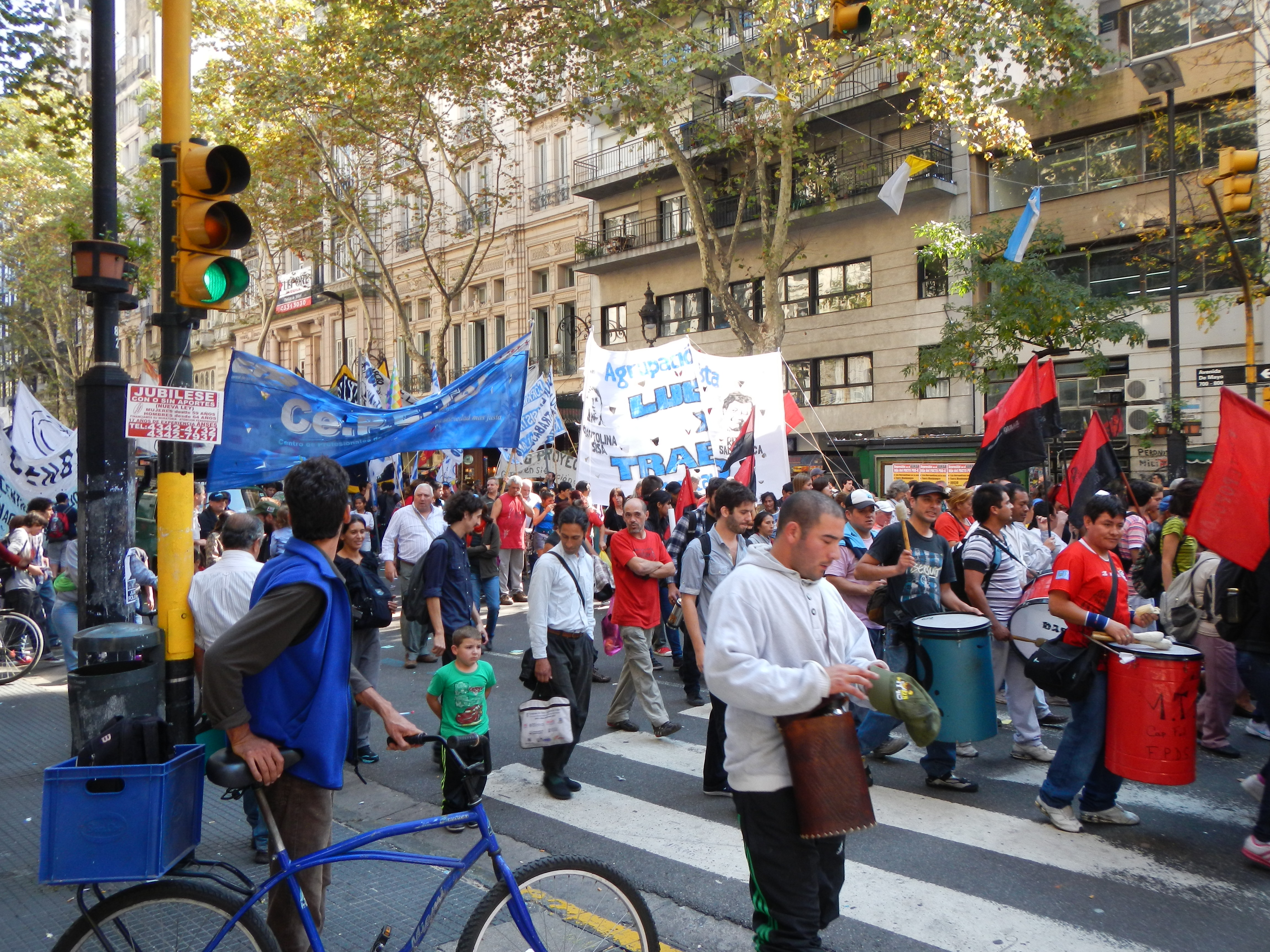
Chaos
Farah then lies that capital flight is “massive”. In fact, strict capital controls last year brought capital leakage down to its lowest level since 2006. During the first quarter of the year capital flowed in, compared with a net outflow in the same period the year before.
In order to hide her sins, Kirchner is supposed to have “moved aggressively” to “neuter” the independent judiciary. I’m no dog, but surely neutering isn’t something that happens by degree; either you’ve got balls or you haven’t.
Farah charges that the government has spent millions of dollars advertising the state-owned media. Imagine the BBC advertised itself. Would it ever dare?
It’s when the article moves on to international relations that the anger really begins to pulsate from the page.
Argentina has committed the abominable crime of antagonizing the United States. What this really means is that Buenos Aires refuses to follow Washington’s edicts on free trade and said that it won’t pay the billion dollars in bond repayments demanded by an American vulture fund following the country’s 2002 sovereign default.
Somehow connected with this, Kirchner is “growing ever closer to Iran”, which is, as if we didn’t know, a US-designated state sponsor of terrorism allied with Venezuela, and – wait for it – Cuba! No evidence is presented for this alleged Tehranian cosiness, and it’s almost as if being close to Venezuela and Cuba is seen as worse.
The intention, of course, is to insinuate the word terrorism into the paragraph so as further to besmirch Kirchner. Even mention of the word Cuba is designed to provoke an attack of eye-rolling and teeth-clenching among the American corporate class.
Next Kirchner morphs into cocaine dealer. At this stage I was beginning to wonder if the author would somehow explode across the page like a red-faced cartoon balloon.
Apparently the country is a way-station for Bolivian and Peruvian drugs heading to Europe. This is apparently a result of policies peddled by a group of presidential advisers who, in an alleged long-term plan to dominate politics blend Marxist, fascist and utopian policies.
If successful they’ll surely be the first to do so. What would they call their ideology? Narco-Mussoleninism? National coke-ialism?
Farah seems to forget that Argentina now has a functioning democracy in which people are free to vote out those that they don’t like. Kirchner was re-elected two years ago with 57% of the vote, compared with 17% for her nearest challenger, although her support has since declined. Not that democracy has worried the US in the past – Guatemala, Nicaragua, Haiti, Cuba, Chile?
In my four months in Argentina I met not a single person who so vociferously opposed Kirchner. Some were critical, like the physicist we met near Bariloche who worried about the upturn in crime and inflation but who was glad that the government was addressing poverty. Or the nurse from Buenos Aires who similarly admired the president’s egalitarianism but said she should do more to tackle the big landowners who withhold agricultural produce so as to maintain high prices.
The right-wing international press ignore the reality that the economy grew faster than Europe’s or America’s during the decade of rule by Kirchner and her husband, who preceded her as president, and faster than at any time in recent decades. Poverty tumbled to historic lows even using the figures of the political opposition. National debt is lower than in Europe and the US. The jobless rate is below Europe’s and roughly the same as in the States.
You get the sense that the author is slinging every nasty slur he can think of and hoping that one might stick: money-laundering, Iran, drugs, fascism, Marxism. Couldn’t he have worked paedophilia in somewhere, too?
His conclusion is that the United States should treat Argentina as a rogue state. Soon there’ll be no non-rogue states left. Is there some sort of register of countries due for promotion to the axis of evil?
Contrast the Foreign Policy axe-job with the measured positivity of the June edition of the New Internationalist.
Admitting that not everything about the current government is rosy, such as its deafness about indigenous rights and its authoritarian leanings, the magazine instead asks whether certain features of Argentinean society might even present a model for others to follow.
New Internationalist quotes Arnaldo Bocco, former director of the Central Bank, as saying that Argentina may be pursuing an unorthodox economic policy but that the country is “not in crisis”. Chief among the achievements he cites is the repayment of almost the country’s entire foreign debt stock by 2012, with the ratio falling from 120% of GDP in 2003 to 14% in 2012. In fact, he thinks, the economy may be the government’s strong suit at the October 2013 mid-term elections. (I doubt it. Spiralling inflation and capital controls will cut Kirchner’s majority).
Progress on human rights has been rapid, with the government passing one of the most progressive laws defending the rights of transgender people and three years ago legalising gay marriage. Progress has been made in bringing to justice the perpetrators of the 1976-83 “dirty war” in which an alleged 30,000 opponents of the dictatorship were tortured, raped and killed.
A host of new worker-owned companies have sprung up. Last year 6,024 new co-operatives launched in industries from medicine to manufacturing. Workers are spurning government help and deciding to run companies themselves. People are beginning to realise the inevitable shortcomings of the state – especially in a country so huge and diverse
Some European crisis-hit countries are following the Argentinean example, occupying ailing factories and running themselves and running popular assemblies modelled on those founded by Argentineans a decade earlier. Surely here the New Internationalistas betray a hint of hippy optimism?
Farah, of course, is preaching to the converted. Most fans of Foreign Policy magazine don’t want to hear the truth. They’d prefer to have their prejudices not so much confirmed as rammed back down their own gullets.
At least the New Internationalist tries to present a balanced view, one which recognises the difficulties of any government in cobbling together a fair economic policy in the face of fierce international pressures, and which recognises the agency and dynamism of ordinary people.
Argentina my be neither saviour nor scoundrel. Its government may have its faults, but let’s not condemn yet another entire country as rogue.

 Emergent Economics